
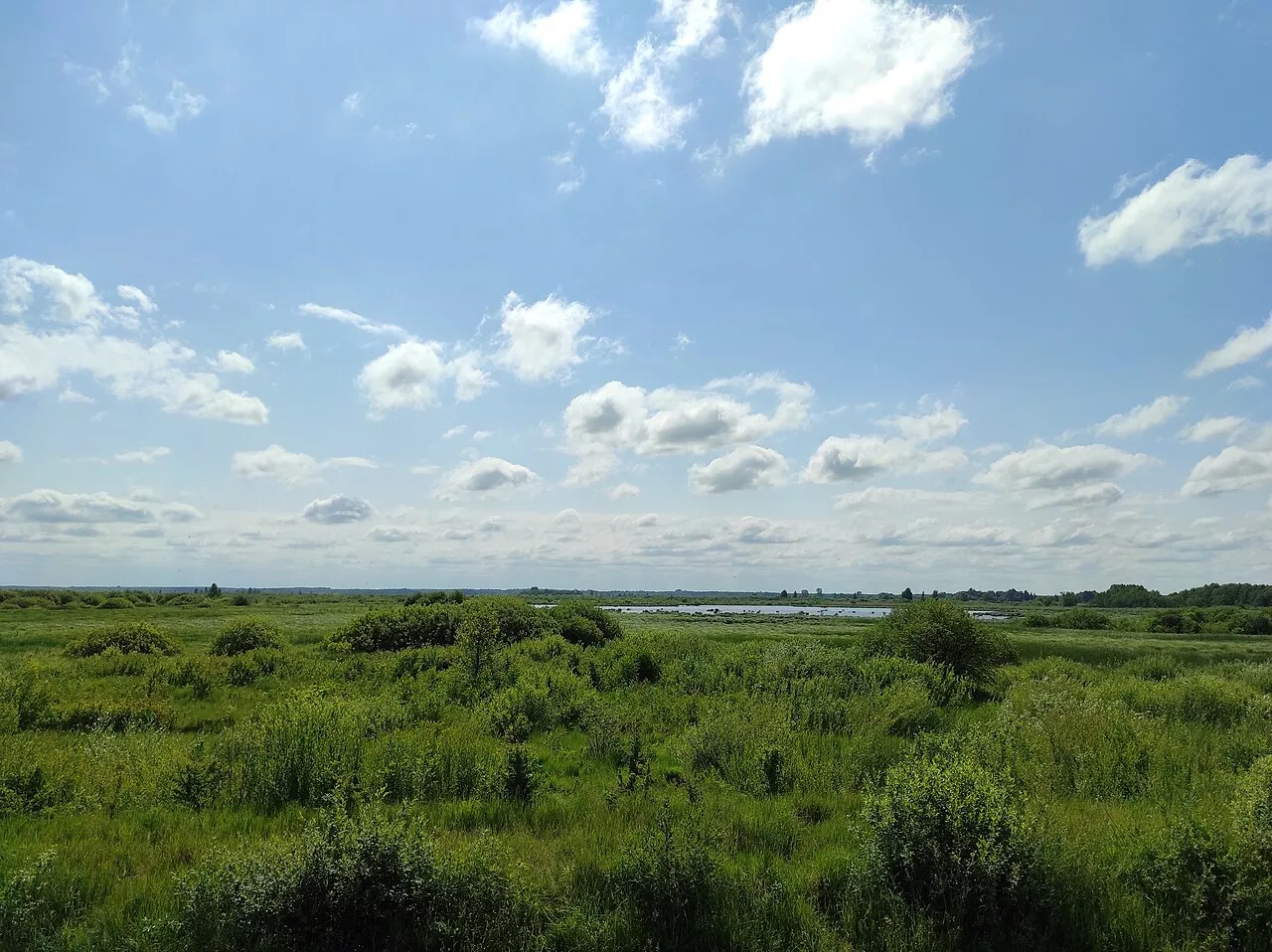
“Czahary” is a nature trail in the Poleski National Park, the first to lead across Bagno Bubnów, the park's largest peatland in Lublin Polissia. It starts in the village of Zastawie near the park's observation tower. The Polish word “czahary” shares the same root as the Ukrainian “chahari” — this is how wet, shrub-covered areas are called in Polissia. According to park data, the length is about 6.5 km (our track is 5.1 km east from Zastawie), taking 2–3 hours. Most of the route consists of wooden boardwalks accessible for wheelchair users and parents with strollers; along the way, there are observation towers, platforms, and shelters.
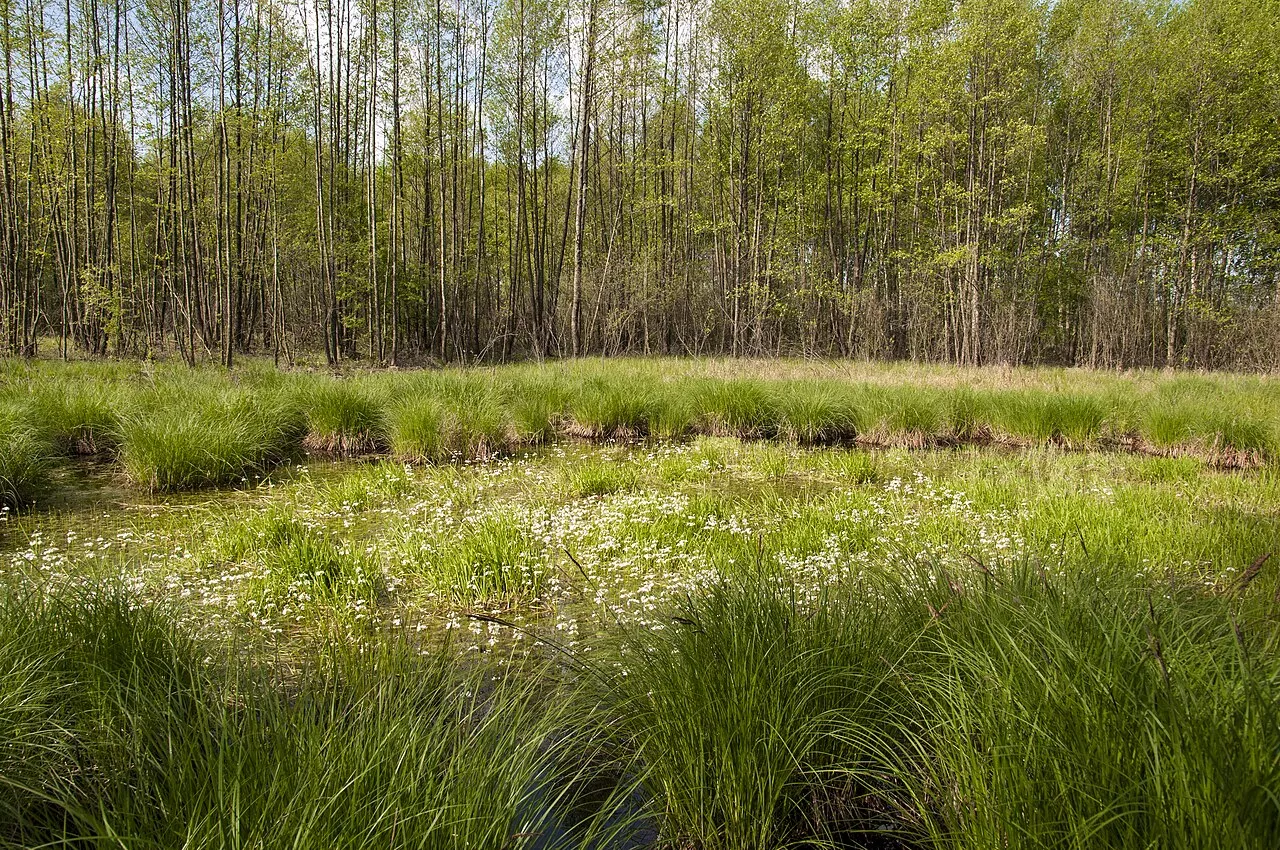
Bagno Bubnów
Bagno Bubnów is a fenland that, together with the neighboring Bagno Staw, was included in the Poleski National Park in 1994. It is an Important Bird Area of international significance (IBA) and a Natura 2000 site. Thirteen species of orchids, fringed pink, Siberian iris, and the rare king lousewort bloom on the bog and purple moor-grass meadows. In autumn, cranes gather on the floodwater near Zastawie before migrating — this is their largest congregation in the region. The crane, by the way, is the symbol of the Poleski Park.
Aquatic warbler
The main inhabitant of the peatland is the aquatic warbler (wodniczka), a small, inconspicuous bird from the Acrocephalidae family and one of Europe's rarest songbirds. About 1% of its global population nests at Bagno Bubnów. This species lives exclusively in open sedge bogs, making Polissia on both sides of the Bug River extremely important for its survival. Nearby nest the Eurasian curlew, snipe, Montagu's harrier, while the marsh fritillary butterfly flies over the meadows. You can also spot moose or red deer.
Poleski Park is part of the West Polesie Transboundary Biosphere Reserve, established together with Polesie Nadbużańskie in Poland and the Shatsk Biosphere Reserve in Ukraine.
How to get there and what to consider
From Urszulin (Route No. 82 Lublin – Włodawa), drive towards Wereszczyn and turn left to Zastawie in less than 2 km — then drive another 3.5 km to the observation tower at the start of the trail. Near the first tower, there is free parking for cars and buses. For families with young children and people with disabilities, there are parking areas a kilometer further, near the entrance to the boardwalk, as well as from the direction of the village of Kulczyn. From the direction of Hańsk, you can arrive via Kulczyn and Pikulawka, and from the Urszulin – Hańsk road, turn south onto a dirt road in Wincentyn.
There is little shade on the route: bring a hat and water. In summer, there are many mosquitoes and horseflies over the bog, and ticks in the grass. Boardwalks can be slippery after rain and frost.
Admission to the trail requires a ticket. As of autumn 2026, a single-trail ticket costs 7 PLN (discounted — 3.5 PLN), a day pass for all five paid trails in the park costs 16 PLN, and a three-day pass costs 21 PLN. Tickets are sold online and at the park management office in Urszulin (ul. Lubelska 3a). Walking on the trails is permitted from dawn to dusk, strictly along the marked route; groups of more than 10 people must arrange their visit with the park in advance.
This is Poland: Ukrainian citizens need a valid passport for travel abroad.