Among the hundreds of estates of Right-Bank Ukraine destroyed or ruined in the 20th century, the Raciborowski Palace in the village of Volytsia has miraculously survived. Today, it houses a village school. But the walls remember a different time.
Architecture: Classicism on the Edge of the Village
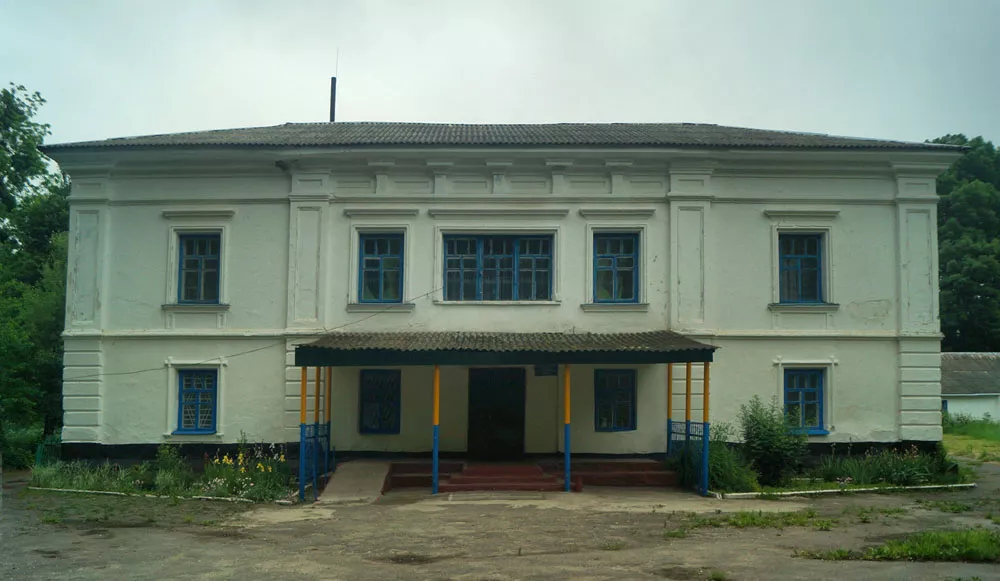
In the village of Volytsia in the Andrushivka hromada of the Zhytomyr region, a small classical palace of the Raciborowski family dating back to the mid-19th century has been preserved. It is modest in scale, but interesting for its destiny and family history.
Originally, only a single-story homestead stood on this site. Around the mid-19th century, a two-story palace in the classical style was added to one of its gables — featuring a symmetrical facade, strict proportions, and simple cornices. In old photographs, the Raciborowski coat of arms cartouche with a noble crown is clearly visible on the front facade.
The Raciborowski Family: Who They Were
The noble family of Raciborowski has a wide geography — their estates and homesteads have been preserved in Kamianets-Podilskyi, Makiv, Derazhnia, Lviv, and Volodymyr. One of the branches of this family settled in Volytsia, which at the time was called Volytsia-Zarubynetska and was part of the Khodorkiv volost of the Skvyra povit in the Kyiv gubernia.
The first known owner of the estate was Zygmunt Stanisław Raciborowski (born in 1806) — the son of a stolnyk and chamberlain of the Polish court. He married Teresa Pruszyńska, and the estate became her dowry. He managed the estate together with his brother Bronisław under the guardianship of their mother, Teresa Raciborowska.
Zygmunt died childless. Bronisław married Maria Marszycka, and it was their descendants who concluded the family saga in Volytsia.
A Dark Page: The Case of Cruel Treatment of Serfs
Documents have been preserved in the archives regarding a court case from 1849–1860 against landowner Raciborowska in Volytsia-Zarubynetska for cruel treatment of peasants. The case lasted 11 years; shortly after its conclusion, in 1861, serfdom was abolished.
The Secret School and the Last Owners
In 1910, a secret Polish school was opened in the Raciborowski estate, where children of both Catholics and Orthodox Christians studied. The Polish language and prayers were taught there. Such schools spread after the defeat of the Polish uprisings — between 1908 and 1910 alone, the police of the Kyiv gubernia uncovered 29 similar institutions.
The last owner of the estate was Maria Ścibor-Rylska (née Raciborowska) — the granddaughter of Bronisław. She married Oskar Ścibor-Rylski, a relative of the poet Maksym Rylskyi. Their son Zbigniew Ścibor-Rylski (1917–2018) became a general of the Polish army, a participant in the Warsaw Uprising, and lived for over a hundred years.
The family lived in the estate until 1918, after which they left through Kyiv for Poland — they were helped by a doctor, the commander of a medical train.
What Has Survived Today
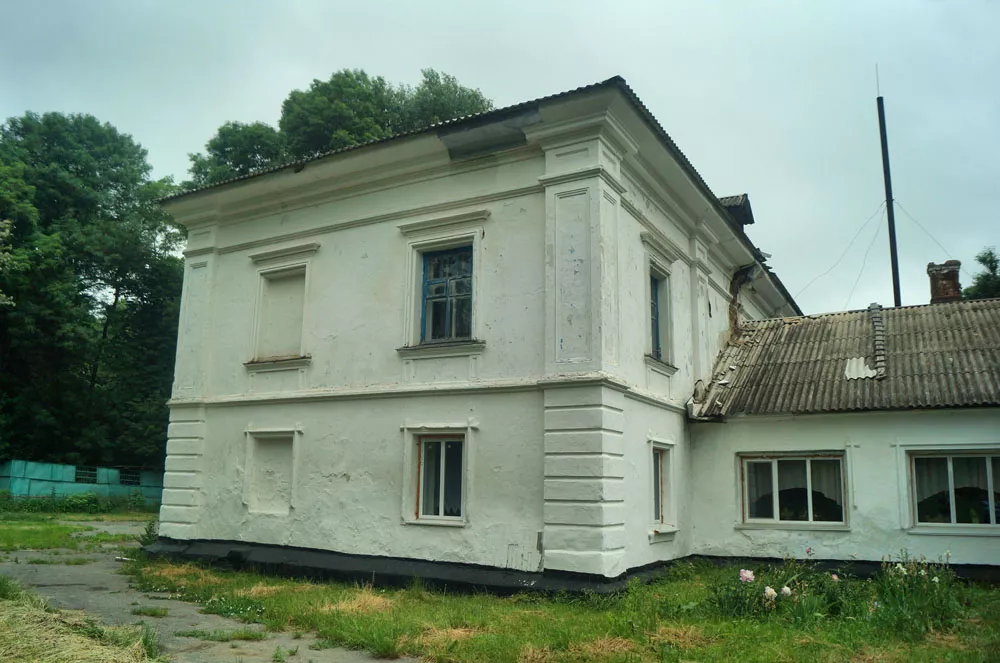
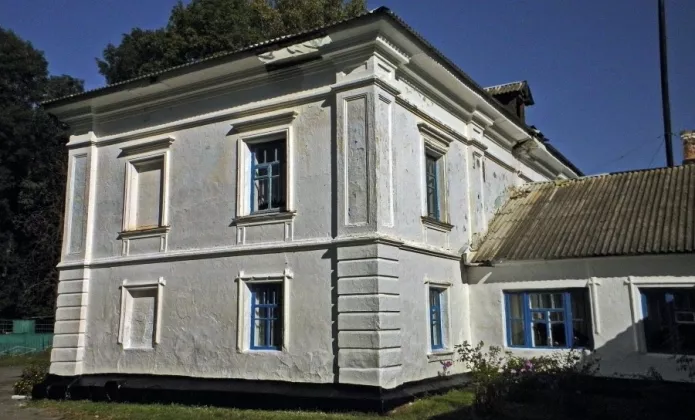
After nationalization in Soviet times, the building was adapted for various needs, and later a general secondary school was housed in it — this helped the palace survive, although externally it is in need of restoration. According to the recollections of local resident D. S. Polishchuk, the old wooden stairs from the first floor to the second have been preserved inside. A park planted with fir trees once surrounded the school — only a part of the chestnut alley remains from it.
There was an old wooden church in the village, which was dismantled in the 1930s. Private houses now stand in its place, and the material from the church was used to build the village club. According to old-timers, not far from the club there was also a brick chapel, the foundations of which served as the burial vault of the Raciborowski family. The chapel was also demolished.
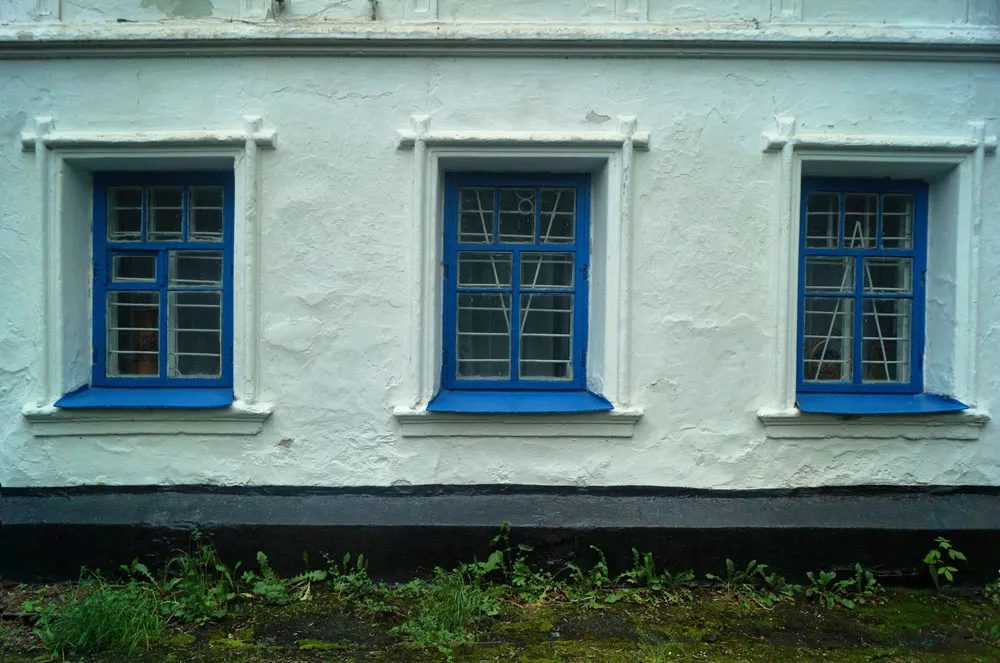
Photo by Roman Malenkov
Visiting
The building operates as a school, so you can only get inside with the administration's permission. You can view the exterior of the palace at any time. It is convenient to combine the trip with a bicycle ride through the surrounding villages of the Andrushivka region.
How to get there
Volytsia is a village on the left bank of the Ivianka River, a tributary of the Teteriv, 9 km northeast of Andrushivka and 7 km from the Stepok railway station. The Zhytomyr — Skvyra highway runs through the village.
If you are driving along the Zhytomyr — Popilnia highway, at the end of Volytsia on the right there will be an abandoned Soviet building. The palace stands behind it — it is not visible from the road.
We thank researchers Ihor Dovbysh, Ihor Dorozhko, and Serhii Shcherbii for preserving the memory of this place.