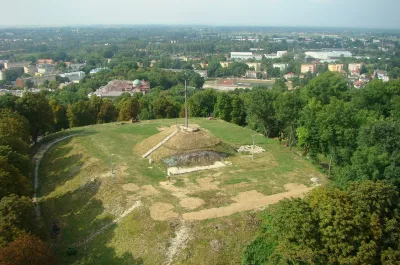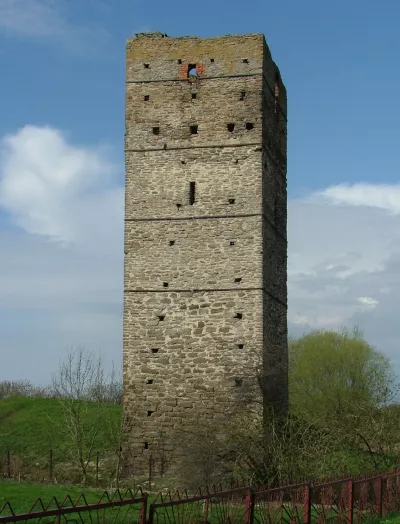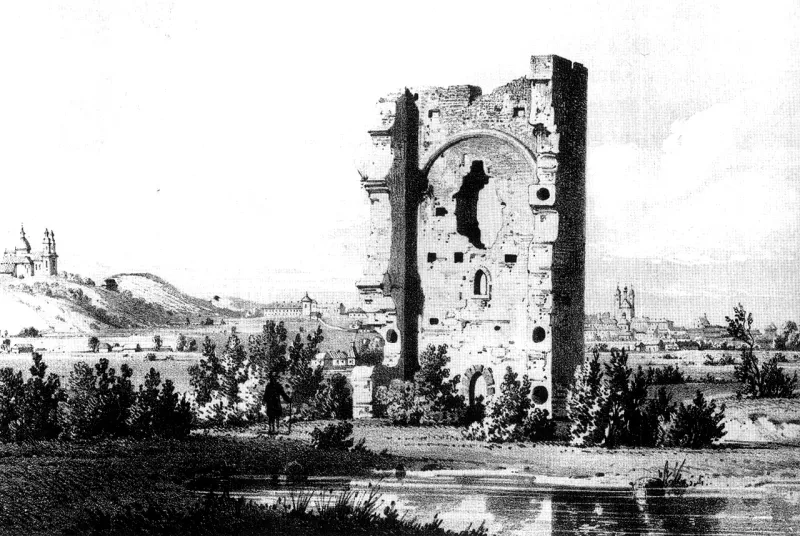
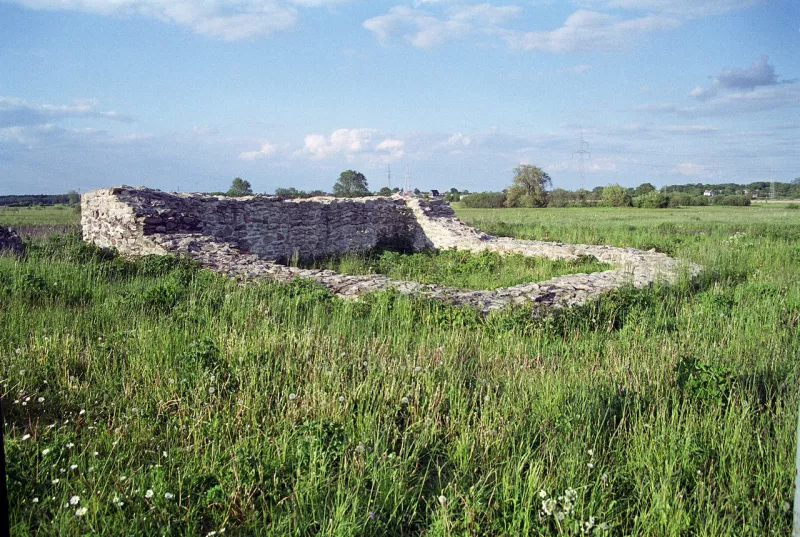

The tower in Bieławin (Wieża w Bieławinie) is the remains of a stone tower from the 13th–14th centuries on the northern outskirts of Chełm, in the floodplain of the Uherka River. Only the conserved foundation of the structure remains, but it is one of the oldest masonry monuments of the Chełm region, associated with the era of Danylo Halytskyi and his descendants. Together with the tower in Stolp’ia, it is considered part of the fortifications around the princely Chełm, the center of which was Vysoka Hirka.
Pillar above the floodplain
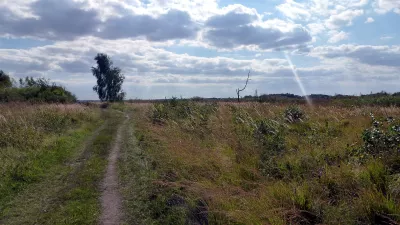
The tower stood in a naturally protected location—on an oval hill among ancient oxbows and floods of the Uherka and its tributaries Harka and Slyshivka. Now there are meadows around. Local residents called the structure a “pillar” (in Polish słup or stołp), and the surrounding area was called Zasłupia. The quadrangular tower measured 12.4 by 11.8 meters externally and was built of broken limestone on a lime mortar. Nearby there was once a spring mentioned in 1646 by the future Uniate bishop Yakiv Susha; after land reclamation, it dried up.
Five tiers
According to archaeologists, in the second half of the 13th and in the 14th century, the tower served simultaneously as a dwelling, a representative residence, and a fortification. The blind first tier housed a kitchen and a storeroom with a small cellar lined with wood—an iron key was found at its bottom. The second and third floors with wooden ceilings were residential. The fourth was ceremonial: a floor of glazed tiles, plastered and possibly painted walls, carved window and door frames, a ribbed cross vault made of glazed bricks and green glauconite stone, and outside—a wooden gallery. The fifth tier was a watch post.
Around the tower, on an area of about 20 hectares, archaeologists found a settlement that existed long before the tower, from the 6th to the 14th century; at the turn of the 13th–14th centuries, it had proto-urban features. No remains of a rampart have been found. Who exactly built the tower is unknown. Some researchers link it to the chronicle mention in 1259 of towers that Danylo erected around Chełm, while others suggest it was built by Danylo’s grandson Yurii Lvivych during his father Prince Lev’s lifetime.
Destruction and legends
The tower was probably destroyed in the second half of the 14th century during the Polish-Lithuanian struggle for Volyn and the Chełm region. In the mid-19th century, its ruins were drawn by Adam Lerue for the “Lublin Album,” and before World War II, almost the entire northern wall still stood. On April 1, 1944, German troops destroyed it. In the 1990s, the ruins were conserved by rebuilding them with surviving stones. Ancient legends recorded by Susha considered both towers, in Bieławin and Stolp’ia, pagan shrines, and ethnographer Stanisław Cercha noted in 1912 that in Stolp’ia they honored “Lelyum-Polelyum,” and in Bieławin—“Swistum-Poswistum.”
How to get there
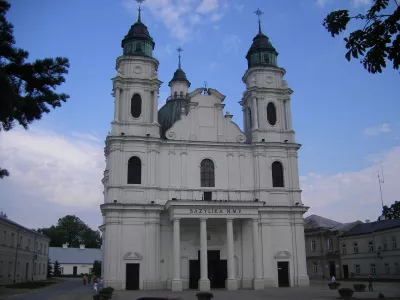
The tower is on the northern edge of Chełm, in the Bieławin district, about 3 km north of Vysoka Hirka. There is no access road directly to the ruins, and the meadows around are wet, so the last part of the route must be walked on foot, and after rain it is muddy. Chełm lies on route No. 12 Lublin–Dorohusk: about 70 km from Lublin, about 25 km from the Dorohusk–Yahodyn border crossing with Volyn. In the city, it is worth visiting Vysoka Hirka and the Nativity of the Blessed Virgin Mary Cathedral, and a few kilometers southwest of Chełm—the tower in Stolp’ia, the closest “relative” of the Bieławin tower. Ukrainian citizens need a foreign passport.