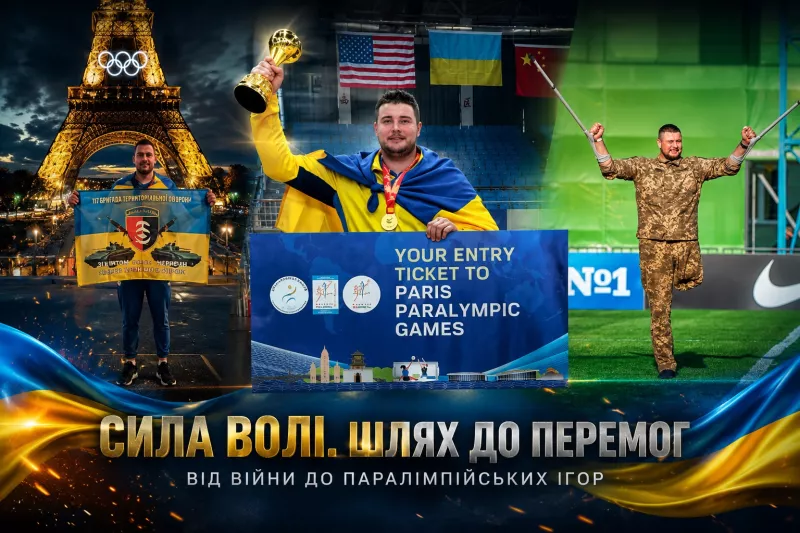

He carried the wounded out under fire near Bakhmut, came close to dying himself, lost a leg — but never lost himself. Today Yevhenii Korinets is a Master of Sport, a Paralympian, a volunteer, and a man whose own example gives his fellow soldiers back their faith. His story is one of war and pain, but also of a strong family, extraordinary twists of fate, and a pair of shoes that became a family symbol of resilience.
A volunteer from day one
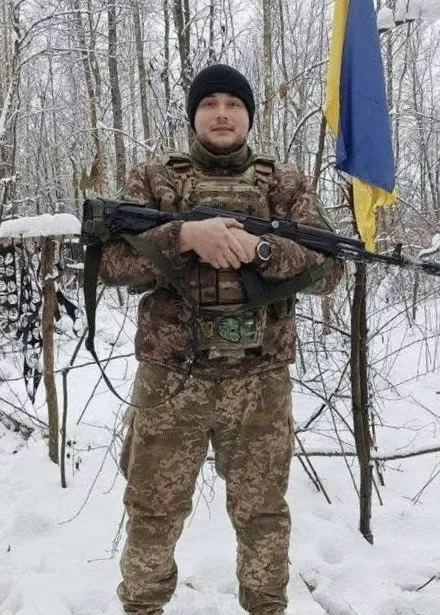
Yevhenii stepped up to defend his country on the very first day of the full-scale invasion, joining as a volunteer. At first he served in the Zhytomyr region — guarding key sites, building fortifications, helping to track down enemy sabotage-and-reconnaissance groups. Later he was transferred to the 30th Separate Mechanized Brigade, then operating on the Bakhmut front near Minkivka. It was there that he worked as a combat medic, dragging the wounded to safety under relentless shelling.
The night he will never forget
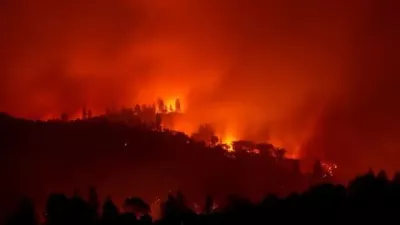
23 March 2023 was the day that changed everything. As the team evacuated the dead and wounded, an enemy drone spotted the medics — and a long artillery barrage followed.
"I was a combat medic, so I knew there was no time to lose: I had to treat myself. We were caught during the evacuation. The shelling ran from about one in the morning until five, and they hit us with everything — a tank, an IFV, an automatic grenade launcher. The position was simply churned into the ground. There were many dead and wounded; only about one or two of us were still able to fight, and the radios had gone silent under fire. My comrade — call sign 'Patron,' from Khoroshiv — and I were sitting in a pit when a mortar round landed in it. Patron was killed instantly, and my left leg and arm were torn up," Yevhenii recalls.
He lost so much blood that doctors put his chances of survival at around ten percent. His future wife was even told to prepare for the worst. What pulled him through was willpower and a firm decision — to fight.
The rehab specialist who saved himself
In civilian life Yevhenii had worked as a rehabilitation therapist and physiotherapist, so no one understood the cost of lost time in recovery better than he did. Within a week of being moved to Kyiv he was getting out of bed, demanding exertion and asking his family to bring hand expanders and resistance bands. At the same time he helped another badly wounded man — a soldier with a double amputation — build a proper recovery routine, effectively sparing him from complications.
And before his eyes, always, was the example of his father.
"At least we'll buy one pair of shoes for the two of us"
Serhii Mykolaiovych, Yevhenii's father, remembers his son with particular tenderness: active and sporty from childhood. First his father drove him and the other boys to Zhytomyr for aikido; later, volleyball became his real passion. His choice of profession was no accident either: Serhii Mykolaiovych has taught physical education all his life, and his son followed a similar path — earning a degree in physical education and rehabilitation and, before the war, working as a rehabilitation therapist at an inclusive centre in Cherniakhiv with children who have cerebral palsy.
The hardest days for the family were the days of silence: for nearly a week and a half there was no word from their son. Then, in the middle of the night, came a call from an unknown number.
"'I'm alive, everything's fine, my legs just got nicked a bit by shrapnel…' he said. But we sensed at once that he wasn't telling us everything. I realised he was in intensive care, because I could hear a machine working," the father says.
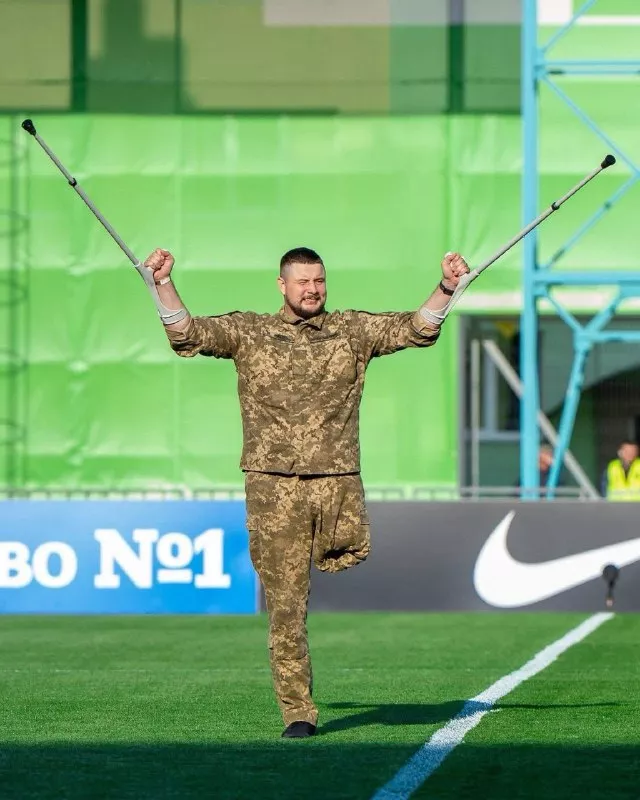
His suspicions were confirmed — the wounds were extremely severe. That their son would have to live without a leg, the family took almost as a sign of fate: the father had lost his right leg in a railway accident in Zhytomyr at the age of 24, and his son lost his left at roughly the same age. Even then Yevhenii did not lose his humour: "At least we'll buy one pair of shoes for the two of us," he joked.
"I never let my family think that life with a disability is limited. Because it isn't. I worked, fished, went hunting, played sports. Zhenia saw that from childhood and knew: even after a loss like this you can live a full life," Serhii Mykolaiovych says.
A prosthesis from the U.S. and a first gold
In Cherniakhiv there is a charity called "Pobratym and Volunteers," which looks after servicemen and veterans. When misfortune struck Yevhenii, volunteer Olha Yanchuk suggested applying for a prosthetic limb.
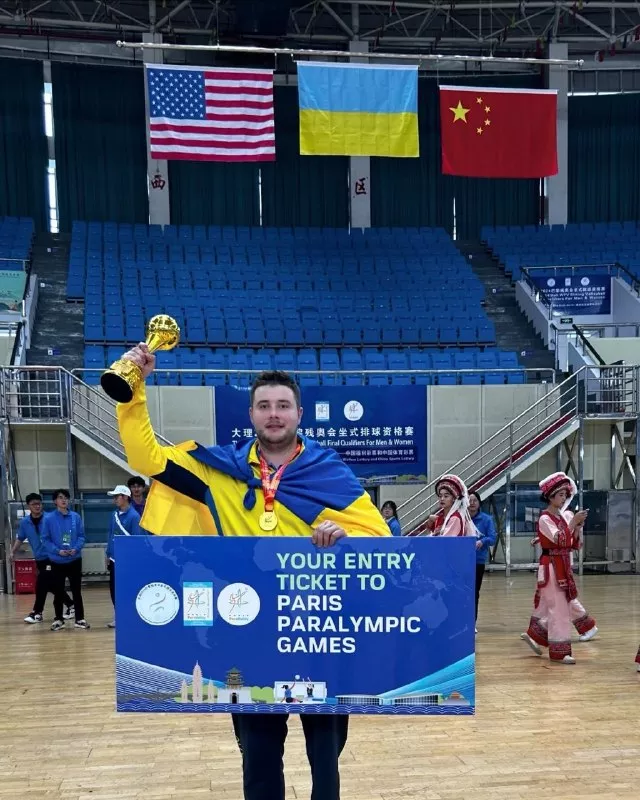
"At the time I was working with an American foundation that did a great deal for Ukrainians. Yevhenii and I filled out an application to the Protez Foundation, and he went to the United States for a prosthesis. He got one of the best prosthetic limbs in the world, and when he came back he threw himself into sport. Before long he went to a qualifying championship in China and took first place. Back home, he pinned his medal on me and said, 'This is your doing.' I will never forget that moment," Olha Yanchuk says.
The dream that brought rescuer and rescued together
Olha says the soldiers her organisation helps often visit her home — the bonds became almost family long ago.
"We had a dream of gathering everyone together at my place, so the guys could meet, talk, remember the good times. And one day it came true. The soldiers arrived, Zhenia and a combat medic named Vitalik among them. And suddenly, at the table, it emerged that it was Vitalik who had pulled Zhenia off the battlefield back in March 2023. Until then, Zhenia hadn't even known who had saved him. I think everyone cried that evening," the volunteer recalls.
Two years on — an embrace instead of a battlefield
For a long time Yevhenii did not know the name of the man who had saved him. Vitalii Kravchenko, a medical instructor with the 30th Brigade who goes by the call sign "Horobchyk" ("Sparrow"), remembers that battle well: 17 wounded and six dead were carried out from under fire that day.
"I remembered his face — unnaturally white. I was terrified he'd die on the way. But he made it. He's strong," Vitalii says.
Their paths never crossed again — until that evening at Olha Yanchuk's home.
"All evening I couldn't place where I knew this guy from. I started asking whether he'd served in the 30th Brigade, remembered that terrible day — and it all fell into place. We hugged and couldn't believe fate had brought us together again, this time not at war," Kravchenko says.
Sport as a second birth
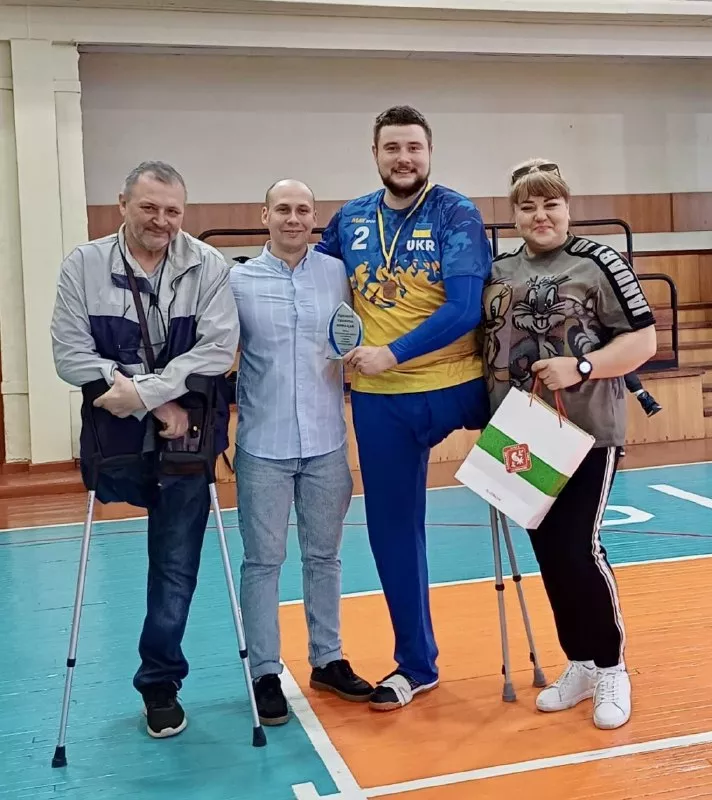
Today Yevhenii not only competes professionally on a team of soldiers with amputations but also lends a shoulder to other wounded men. Before the war he had taken volleyball seriously, and after his injury he tried sitting volleyball — invited into it by Anatolii Denysovets, coach of the regional team. Soon Yevhenii was on the national Paralympic squad, and now he sees it as his mission to bring fellow soldiers into sport.
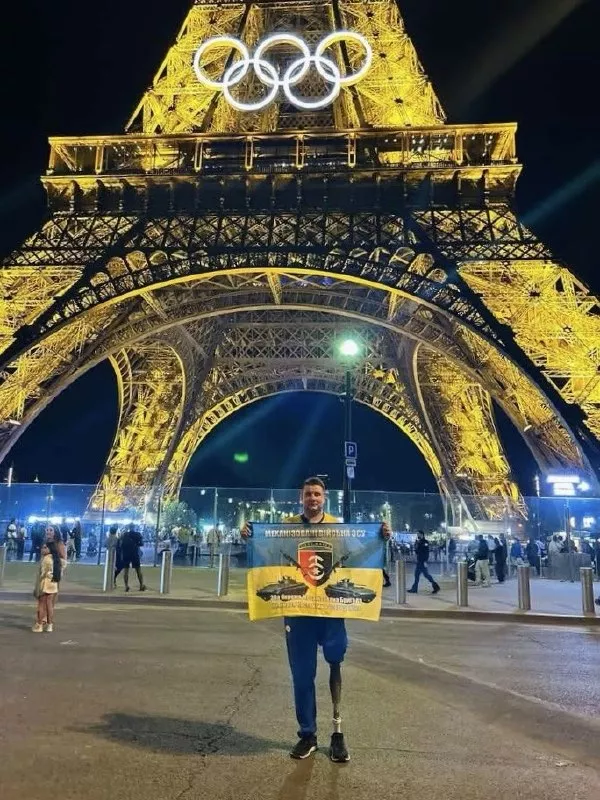
"As a child I saw how my dad lived a full life without a leg — working, fishing, playing sports. So I knew it wasn't a problem. When I meet wounded guys, I walk right up to them on the street and invite them into sport. I want them to believe in themselves the way I believed in myself," he says.
Today Yevhenii Korinets is a Master of Sport and a competitor at the Paris 2024 Paralympic Games, where Ukraine's team finished seventh; he is now defending his country's colours at the world championship in China.
Exactly one year after his injury — on 23 March 2024 — Yevhenii married the woman he loves. The couple are raising a young son. Alongside professional sport, he helps veterans, takes part in volunteer projects supplying vehicles to the military, and supports defenders who have lost limbs, inspiring them not to give up.
His journey is proof that even after the harshest of trials, a person can find a new purpose, the strength to live, and the will to win.
Viktoriia Dubovyk