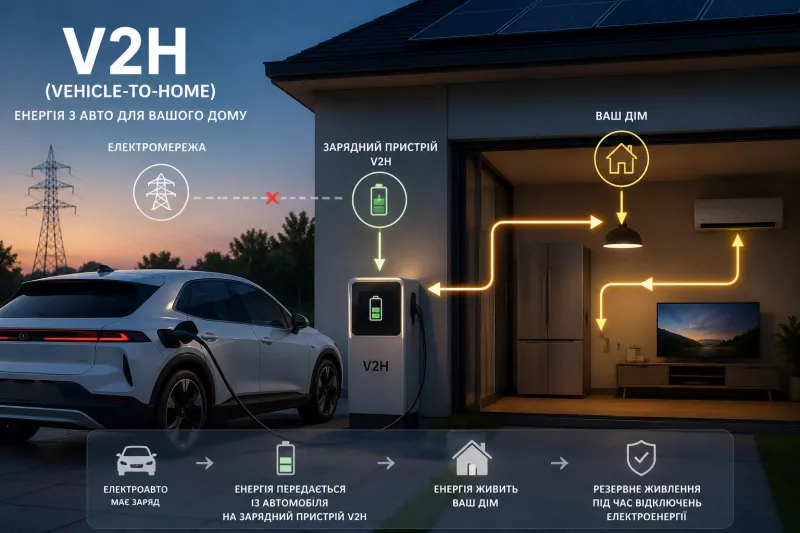

Here's a thought that sounds like science fiction but isn't: the battery in your driveway holds more energy than most home storage systems on the market. A mid-size EV pack can carry 60 to 100 kilowatt-hours—enough to run an average house for days. So why does it just sit there during a blackout? Until recently, the hardware to tap it simply didn't exist for homes. Now it does.
Decoding the acronyms
The jargon is denser than the idea behind it. V2H, vehicle-to-home, means the car sends power into your house—keeping the lights on during an outage, or covering loads when grid power is expensive. V2G, vehicle-to-grid, goes a step further and lets the car feed energy back to the utility, potentially earning money during peak demand. V2X is the umbrella term for all of it: vehicle-to-everything.
The common thread is direction. Ordinary charging is one-way—grid to car. These features make the flow run both ways, which takes a specific piece of equipment.
What makes it work
You can't get two-way power from a standard charger. It requires a bidirectional DC EV charger—hardware that can both fill the battery and pull from it on demand. The Sigen EVDC, a 25 kW two-way unit, is built for exactly this, and when paired with a home battery it can turn the car into 100+ kWh of backup capacity for the house.
The scale of the opportunity is hard to overstate. The International Energy Agency has noted that the collective battery capacity of the global EV fleet already dwarfs stationary storage, and bidirectional standards—developed through bodies like ISO and IEEE—are maturing to let that capacity support homes and grids rather than sitting idle.
The catch worth knowing
Two things gate V2H today. First, the car has to support it—not every EV does yet, though the list grows each year. Second, the home system has to be designed for it, since safely islanding from the grid and back is a coordinated job between the charger, a battery, and the control system. It isn't as simple as plugging in.
Still, the trajectory is clear. As more vehicles ship with bidirectional capability, the driveway battery stops being a missed opportunity. For anyone curious how the pieces fit together, it's worth a look at how two-way charging hardware bridges the car, the home, and the grid into one system—turning a parked EV into something genuinely useful when the power goes out.