Few people know, but among the picturesque landscapes of the Zhytomyr region, near the town of Andrushivka, lies a unique scientific location — the July Morning private astronomical observatory (July Morning Observatory), often called the only one of its kind in Ukraine. It stands in the village of Halchyn and for more than two decades has been a place where Ukrainian astronomers discover new asteroids and observe the secrets of the universe.
Today, this observatory is known not only in Ukraine, but also far beyond its borders. Here, science, enthusiasm, and a true love for space have combined, putting a small village in the Zhytomyr region on the astronomical map of the world.
History of creation: a dream that began with Gagarin's flight
The founder of the observatory was Ukrainian astronomer, Candidate of Physical and Mathematical Sciences Yuriy Ivashchenko, who spent his childhood in Andrushivka. Symbolically, he was born on April 12, 1961 — precisely on the day of the first human space flight. Therefore, his parents named him Yuriy in honor of Yuriy Gagarin.
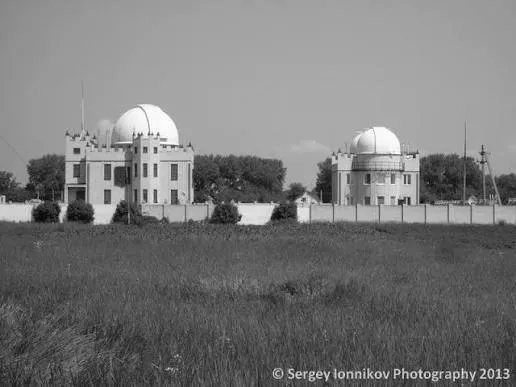
The idea for his own observatory appeared in the late 1990s. In 1998, Yuriy Ivashchenko, together with a group of like-minded people, began construction on the outskirts of Andrushivka.
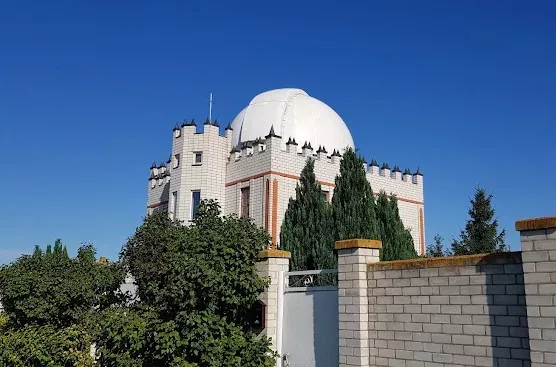
The most difficult stage was the installation of a large astronomical dome, which had previously been stored at the Main Astronomical Observatory of the National Academy of Sciences of Ukraine. This Zeiss dome, with a diameter of 8 meters and a weight of over 6 tons, had not been used for a long time due to a lack of state funding for its installation.
Despite all difficulties, on April 12, 2001, for the 40th anniversary of the first human space flight, the observatory was officially opened. It was named July Morning in honor of the famous composition by the British rock band Uriah Heep, July Morning, which symbolizes the romance of discovery and the human striving for the unknown. The Ukrainian Astronomical Association admitted the observatory as a collective member.
A telescope that looks into the depths of the universe
The main instrument of the observatory is the Zeiss-600 Cassegrain telescope with a main mirror diameter of 60 centimeters. Since 2009, another 60-centimeter reflector has been operating here, designed for observing artificial objects in orbit, and there is a small 12-centimeter telescope for amateur observations.
The observatory conducts observations of:
- asteroids and minor planets;
- artificial Earth satellites;
- space debris;
- planets of the Solar system;
- Saturn's rings;
- Jupiter's satellites;
- phases of Venus.
Work has also been done here to create observation systems capable of recording objects that are approximately a million times fainter than what the human eye can see.
Over 170 asteroids and worldwide recognition
The greatest fame was brought to July Morning by the discovery of minor planets. The first success came on the night of September 19, 2003, when observers recorded a whole group of asteroids. As of 2026, the observatory is credited with over 170 numbered asteroids — some are registered to the Andrushivka team, and some to individual astronomers.
In 2005–2012, it was among the top twenty most productive observatories on the planet for minor planet observations, and in the international ranking of minor planet discoverers, the Andrushivka team ranks 114th (taking into account the personal discoveries of its astronomers, it is around 87th).
Many discovered celestial bodies received names related to Ukraine and the Zhytomyr region. Among them are the asteroids Zhytomyr, Andrushivka, Halchyn, as well as the asteroids Wikipedia and UNESCO.
A tourist highlight of the Zhytomyr region
Today, the Lipnevy Ranok observatory is not only a research center, but also a popular tourist destination. Schoolchildren, students, tourists, and everyone interested in space come here.
During guided tours, visitors can see the huge dome of the observatory, learn about the history of its creation, the work of astronomers, and modern methods of exploring the Universe. The most impressive part is the evening observations of the starry sky through the telescope, weather permitting.
How to get there
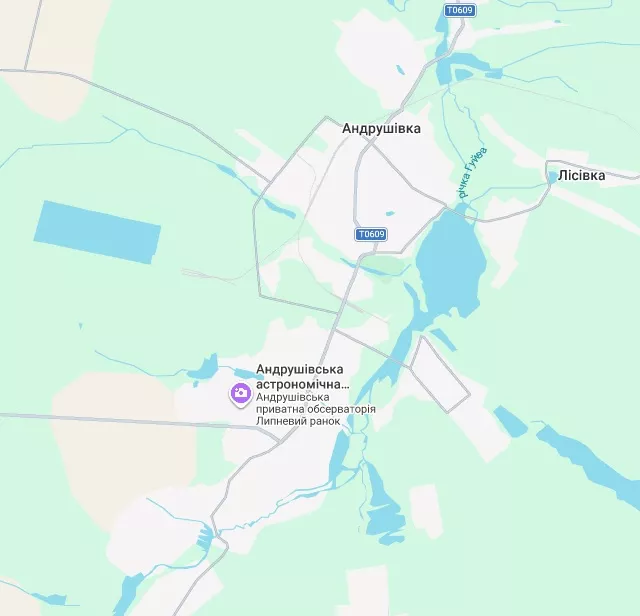
The observatory is located in the village of Halchyn, practically on the southern outskirts of Andrushivka. It can be reached in several ways:
- By car — about 47 km from Zhytomyr, it is also convenient to travel from Berdychiv.
- By bus — regular services connect Andrushivka with Zhytomyr and Berdychiv.
- By train — take a suburban train from Kyiv or Koziatyn to Brovky station, and then take a bus or taxi to Andrushivka and Halchyn.
A place where the Zhytomyr region touched the stars
The Lipnevy Ranok observatory is an example of how the perseverance of a few enthusiasts managed to create a world-class scientific facility far from large cities and research centers.
Among the fields and forests of the Zhytomyr region, for more than 20 years, a place has been operating where space is explored, new celestial bodies are discovered, and it is proven that the path to the stars can begin even in a small Ukrainian village like Halchyn.