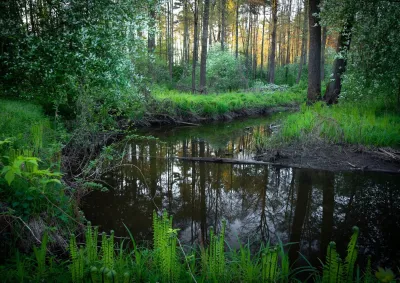
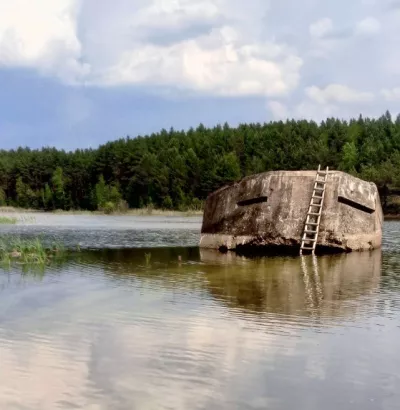
Recently we were traveling from Korosten to Khoroshev (formerly Volodarsk-Volynskyi). Having turned past Staryi Bobryk, we found ourselves in the village of Rizhani on the Irsha river. The bridge across the river turned out to be dismantled, and the water was flowing through several pipes under a sandy dam. The crossing looked unreliable, but our van successfully overcame it.
On the opposite bank of the Irsha we saw a beautiful wooden church that we had not heard of before. It resembles a typical diocesan project with tented roofs, but has additional decorative domes characteristic of wooden churches of Left-Bank Ukraine from the early 20th century.
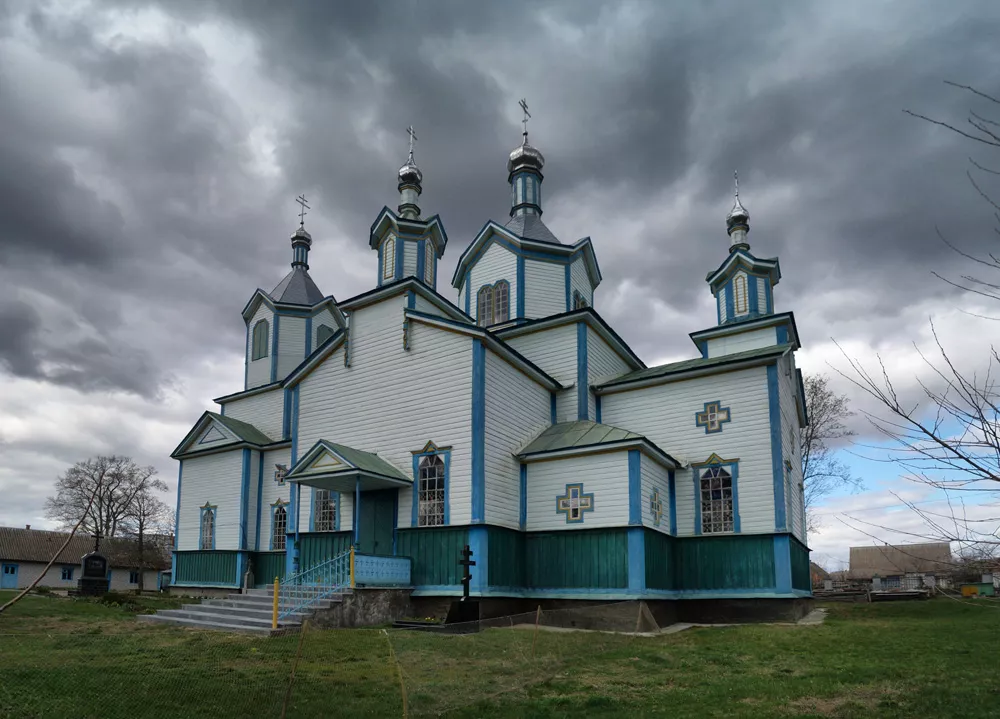
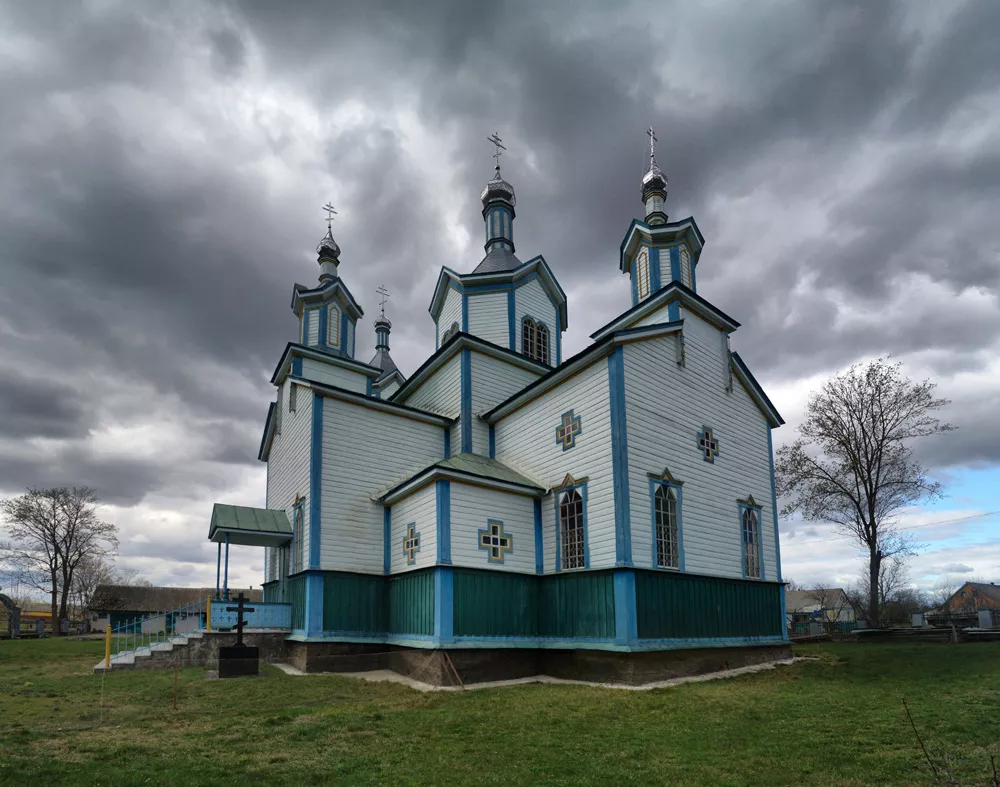
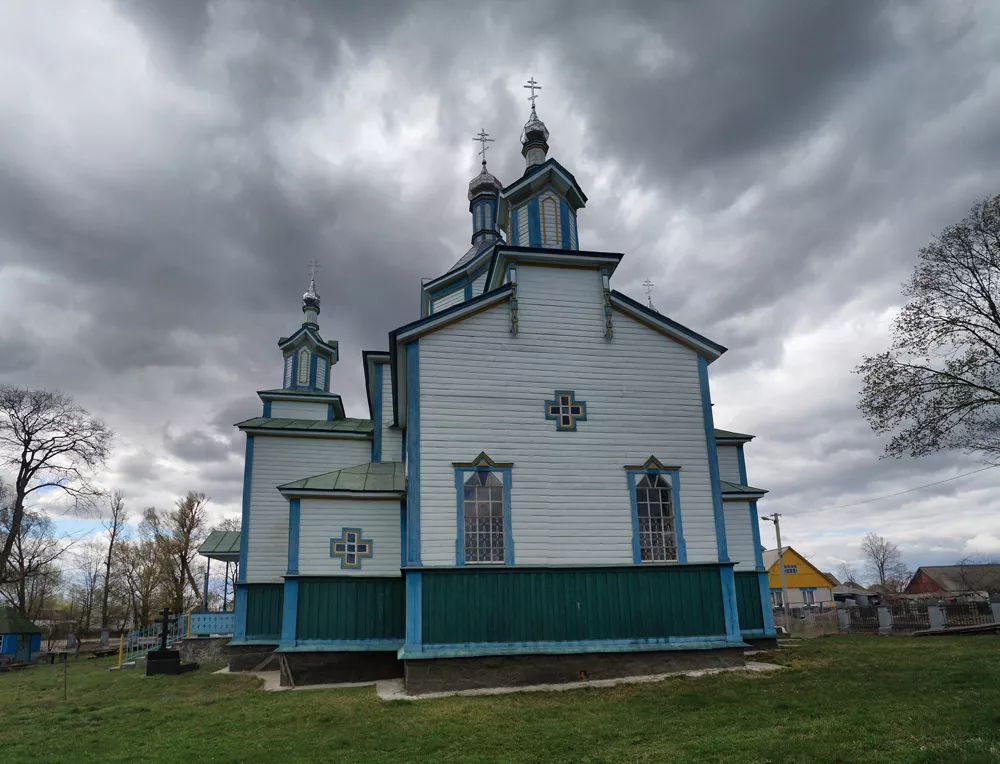
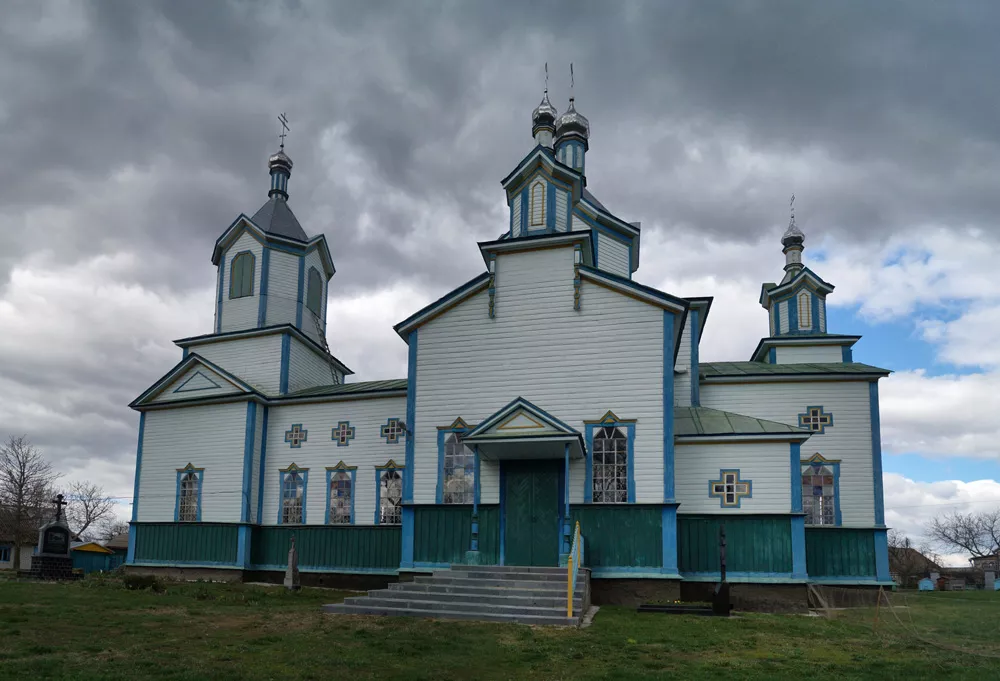
Old and new churches
The first Church of the Nativity of the Theotokos in Rizhani was built in 1777 and had features close to Baroque; its image has been preserved by archival photographs. At the beginning of the 20th century, the old church could no longer accommodate all the parishioners, so the community decided to build a new one. In 1912, the old temple was moved to the village of Nova Bobrytsia (now Bobrytsia of Zviahel district).
How the new temple was built
The parish recounts that the new temple was erected from 1900 to 1914, and the residents actively participated in the construction. One of the locals, Oksion Ostapchuk, along with his family, harvested timber and stone with his own hands. He came up with an original method of stone extraction: he heated it on a bonfire and then struck it with a thick rope, and the stone cracked. Parishioners donated part of their harvest, livestock, and money for the construction.
On June 10, 1912, on the third day of Trinity, the bells of the new temple, which received the old name, rang out in the village. The first wedding in it took place for a couple from the Odvod tract — Sofiia Yakivna and Ivan Petrovych Yushchenko; it was conducted by the rector, Father Romanovskyi. Until 1914, work around the temple was still ongoing, but services had been held in it since 1912. Near the church stood three buildings of a single-class parish school and the priest's house.
Soviet times and war
Since 1924, the church ceased to function — a village club was opened in it. In the 1930s–1950s, the church served as a school gym and a collective farm grain warehouse. In 1937, crosses and bells were removed from the domes; some of the bells were hidden by local residents.
In August 1941, retreating Soviet troops were about to destroy the church as a strategic object. Elder Yosyp Antonovych Danylchuk convinced the commander that the residents would set fire to the temple themselves. People built large bonfires around the church, simulating a fire, and thus saved the shrine. For this, on May 9, 1985, Danylchuk received a Patriarchal certificate.
In November 1941, the occupation authorities allowed the resumption of worship, and since then the church has not been closed, even after the return of Soviet power. Despite anti-religious propaganda, residents continued to go to the church. The walls and the dome still retain traces of bullets and shells, but the church survived. In the post-war years, the murals and iconostasis were restored, and some of the icons and bells were returned by the villagers.
An important role in the life of the parish was played by Father Oleksandr (Osipchuk), who served in Ryzhany from June 1972 until his death on November 12, 2007. He was ordained a priest in Zhytomyr in 1956, and later served in the village of Zholobne. In the Ryzhany parish, he became a spiritual father to many people, served as a dean, and received the highest church awards. Father Oleksandr is buried near the church, and his spiritual children still visit his grave.
Today
Today, the church is in excellent condition. However, the old 1777 church, which was moved to Bobrytsia, has not survived — it was destroyed during the Soviet period.
Ryzhany is part of the Khoroshiv hromada in Zhytomyr Raion. On the way from Korosten to Khoroshiv, people turn here via Staryi Bobryk; the church stands on the bank of the Irsha.
Photos and text by Roman Malenkov, Serhii Shcherbii