In the ancient Polissian town of Ovruch, which was called Vruchiy in the times of Kievan Rus, stands a church whose history spans nearly nine centuries. This is St. Basil's Church (Holy Basil Cathedral), one of the oldest and at the same time one of the most "resurrected" monuments of Old Rus architecture on the territory of modern Ukraine.
The first wooden church and the death of Prince Oleg
The history of the site began long before the stone church. In 977, near Vruchiy, during the retreat of his army, the Drevlian Prince Oleg, brother of the Kievan Prince Yaropolk, died—he fell from a bridge into a moat. According to legend, in memory of this event, Prince Volodymyr Sviatoslavych ordered the construction of a wooden church of Saint Basil the Great; Volodymyr was named Basil at his baptism. Tradition dates the first wooden church on this site to 997.
The stone church of Rurik Rostyslavych
Around 1190, the Grand Prince of Kyiv, Rurik Rostyslavych, who ruled Ovruch and also had the baptismal name Basil, ordered a masonry church to be erected on the site of the wooden one. This date is confirmed by a graffiti inscription found on the wall, which corresponds to 1192.
The church was built by Kievan craftsmen, and its leader was probably Rurik's court architect Petro Mylonig (Myloneg), one of the few Old Rus architects of the pre-Mongol era whose names have been preserved. He is also credited with St. Paraskeva's Church in Chernihiv and the stone retaining wall above the Dnipro near the Vydubychi Monastery in Kyiv, which was admired by contemporaries. The architecture of St. Basil's Church echoes that of Chernihiv's St. Paraskeva's: both churches represent the final stage of the development of Old Rus architecture before the Mongol invasion.
The dome of the church was originally gilded, which is why the people called the church "Zolotoverkha" (Golden-Domed). The building was part of the princely palace complex and stood in front of the entrance to the castle—this explains the narrow galleries inside the walls at the second-floor level: presumably, they had a defensive purpose.
Architecturally, it is a four-column, three-apse, single-domed church with cruciform pillars in plan. The western facade is flanked by two round towers—a rare detail for the 12th century, which researchers associate with the tradition of St. Sophia of Kyiv.
Ruins: Tatars, Lithuanians, and centuries of decline
The peaceful existence of the church did not last long. It was twice looted and destroyed during Tatar raids, and in 1321, when Ovruch was taken by the army of the Grand Duke of Lithuania Gediminas, the structure suffered its heaviest destruction.
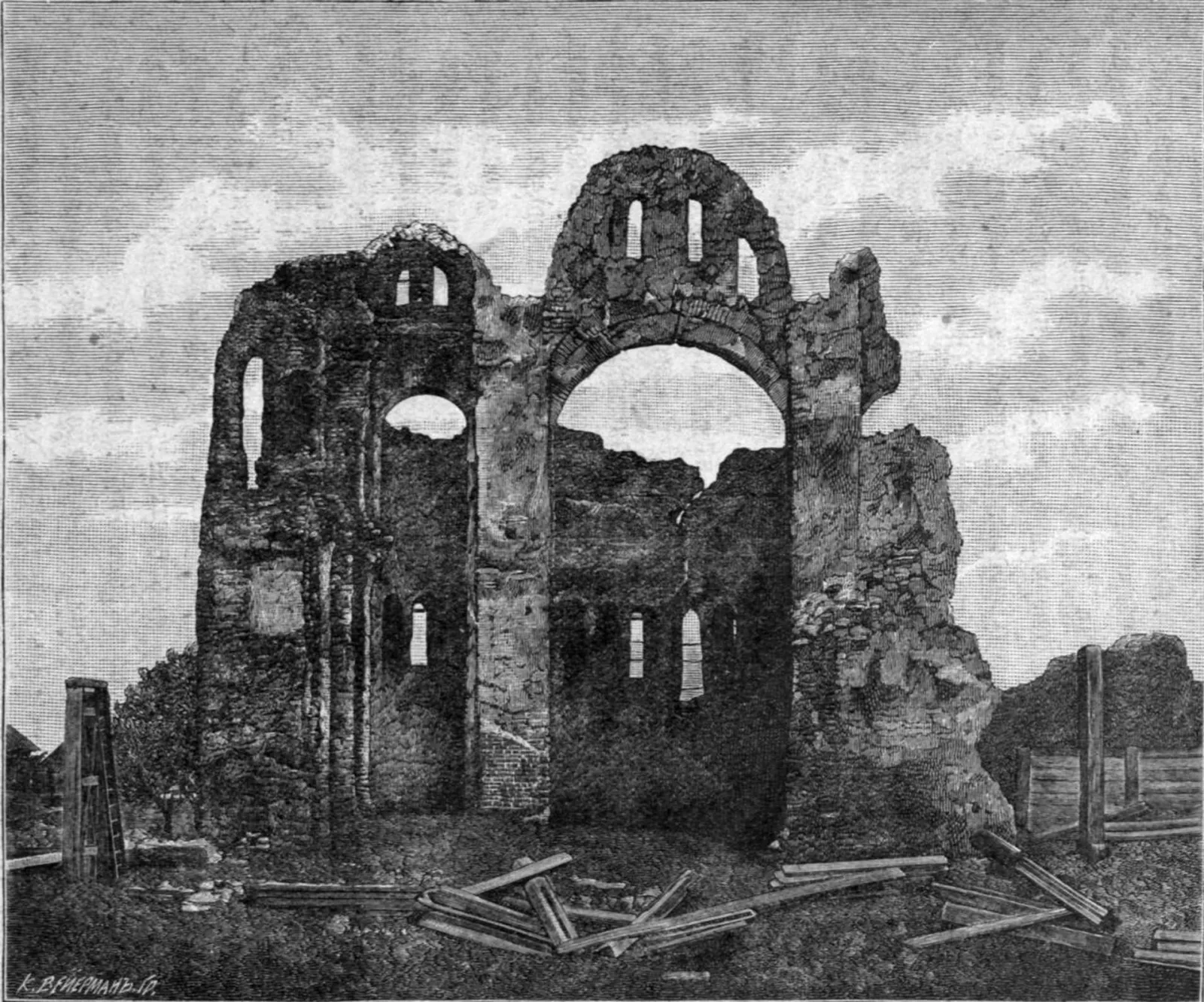
Ruins of the church (before 1908)
In the 16th century, a wooden church was built among the ruins, which soon burned down. Another wooden church inside the old walls was erected in 1734—it saved the ruin from complete destruction. In 1848, the vaults collapsed: three apses and part of the northern wall remained from the Old Rus church.
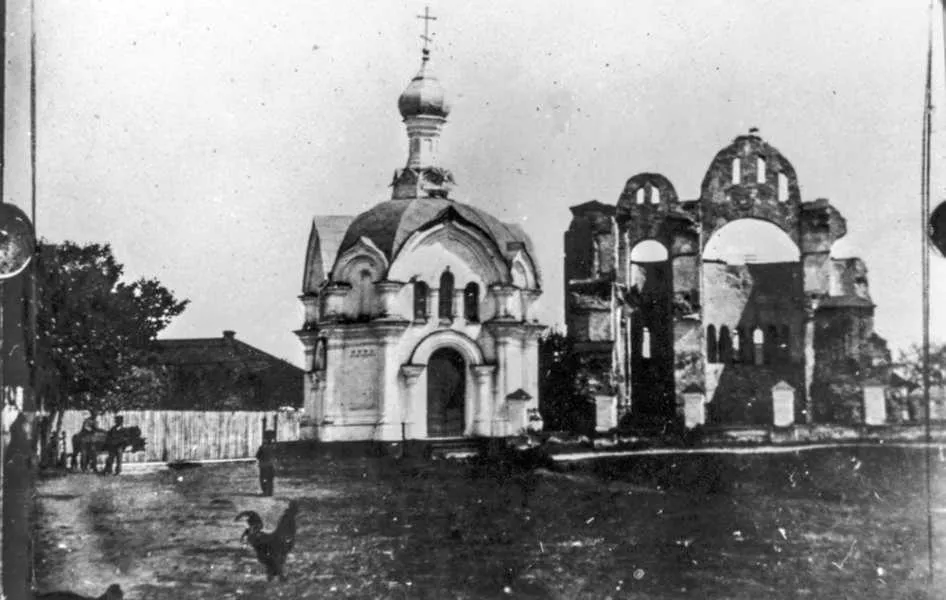
1907. Chapel and ruins of St. Basil's Church
The clearance of the ruins lasted from 1860 to 1877. In 1876, a small chapel was built near the northern wall, which was dismantled in the early 1900s. At that time, the original plaster with remnants of ancient frescoes was still preserved in the apses and window splays.
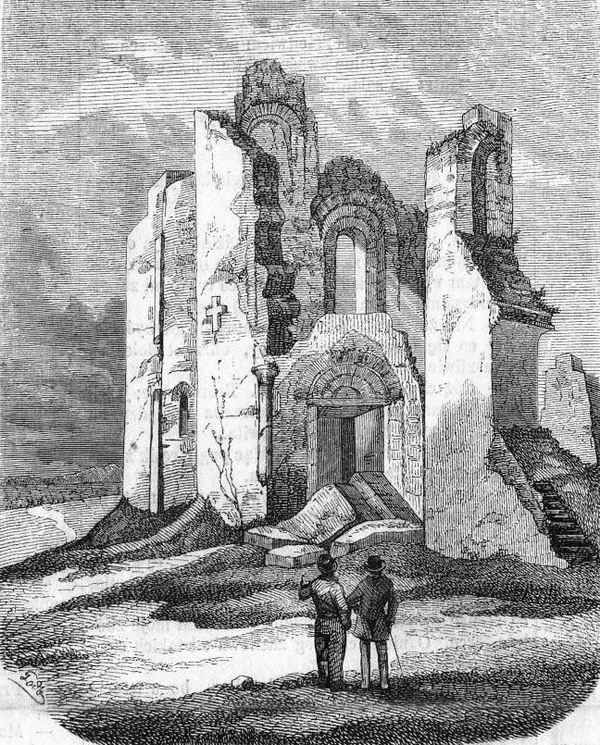
Schusev's rebirth: a restoration that became a school
In 1904, at the initiative of Anthony (Khrapovitsky), Bishop of Volhynia and Zhytomyr, the Volhynia Diocesan Brotherhood petitioned for the restoration of the church. Architect Aleksey Shchusev was dispatched to Ovruch.
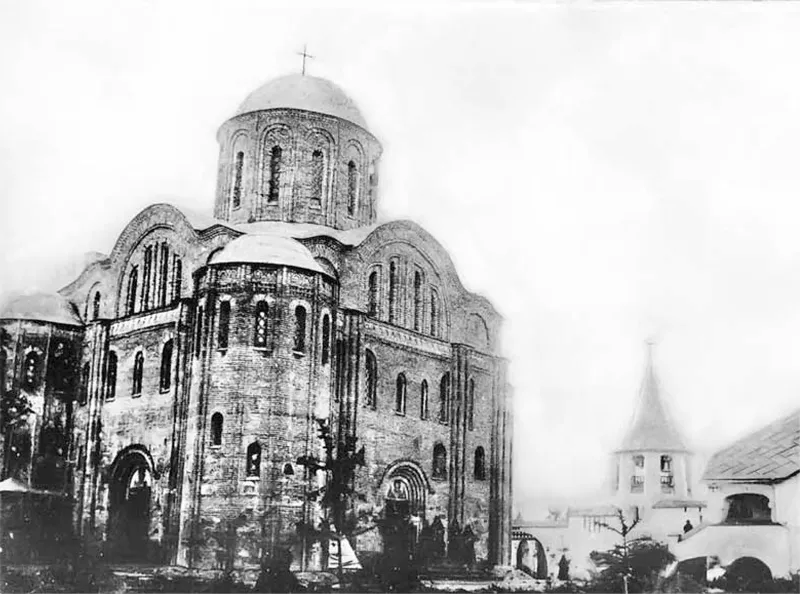
The reconstruction lasted from 1907 to 1909, and the interior paintings were completed in 1910–1911. Based on the research of historian Petro Pokryshkin, Shchusev gathered the remnants of the ancient northern wall brick by brick, and all reliable authentic parts of the ruins were incorporated into the new masonry unchanged. The dome, two towers, and apses were covered with sheet lead, and the main roof with sheet iron.
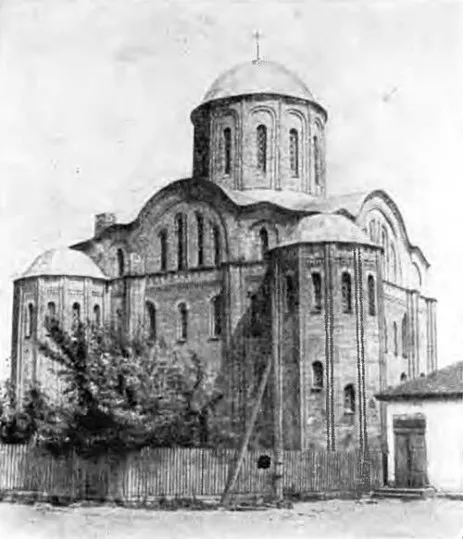
The restoration did not become an exact copy of the original appearance: the completion of the church was modeled after Chernihiv churches, and some of the ancient features were lost. However, this very work initiated the tradition of scientific restoration of monuments in Ukraine. In 1910, Shchusev was awarded the title of Academician of Architecture specifically for the reconstruction of the Ovruch church.
Funds for the restoration were collected throughout the Russian Empire; Emperor Nicholas II was among the donors. At the same time, the St. Basil Women's Monastery was built nearby, featuring a two-story cell block, a refectory, and a bell tower.
Oleksandr Blaznov, Kuzma Petrov-Vodkin (whose paintings adorn the southern tower), Fedir Volkov, and B. Maksymov took part in the interior painting. These paintings are unlike either the Novgorod frescoes or the paintings of St. Volodymyr's Cathedral in Kyiv — they represent an independent art phenomenon of the 20th century on the walls of a 12th-century church.
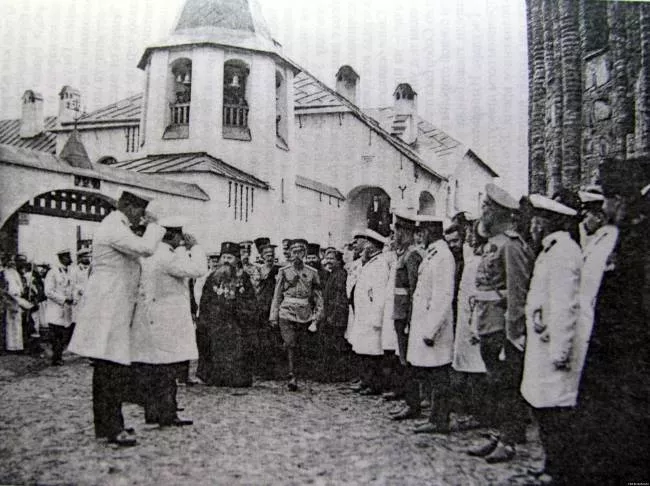
The Emperor's Visit in 1911
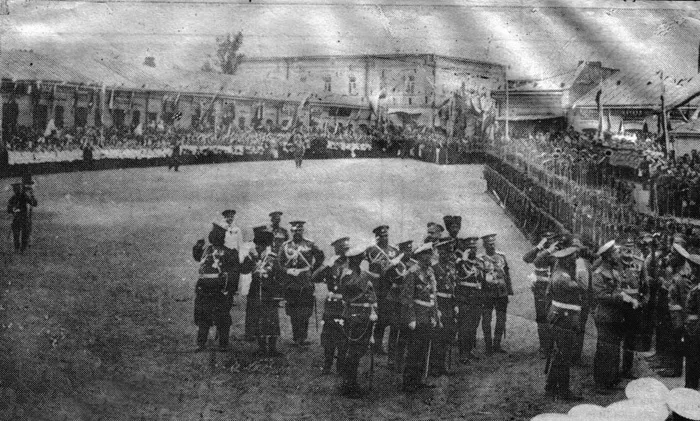
Back in 1909, Nicholas II expressed a desire to attend the consecration of the restored church, and in February 1911 he confirmed his intention to a delegation led by Archbishop Anthony. On September 3, 1911, his arrival in Ovruch became an event for the entire uyezd.
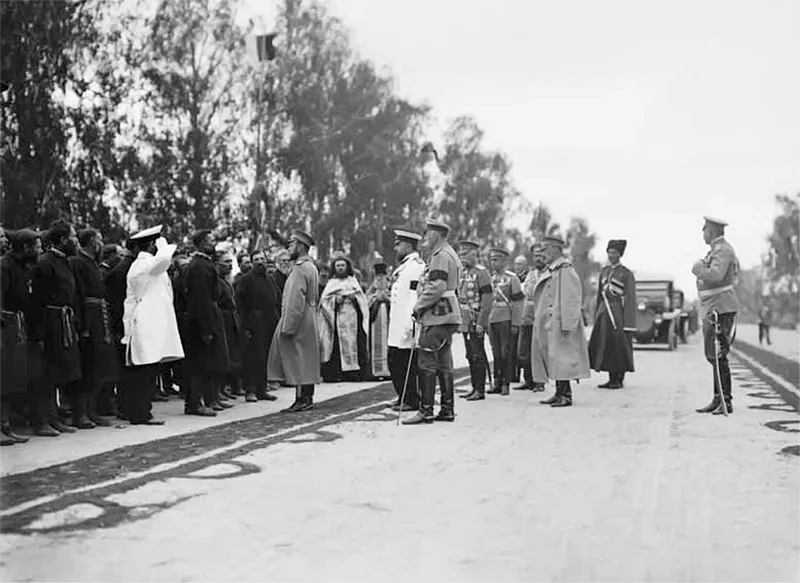
In the morning, the Emperor and his entourage traveled by car from Korosten station to Ovruch. Settlements along the route were decorated with flags, ceremonial arches, flowers, and sheaves. Ahead of the guest's arrival, new paving stones were laid in the center of Ovruch and houses were repaired.
A religious procession led by Archbishop Anthony came out of the church to meet the Emperor. After a speech, the divine service began; as a sign of respect, the Archbishop presented the guest with a church icon of St. Basil the Great, and Abbess Pavla presented a prosphora. Following the liturgy, Shchusev reported to the Emperor on the restoration results, and the Emperor inspected the monastery and returned to Korosten. A photograph by I. Dubynsky has been preserved, capturing the moment of the visit.
Soviet Trials
In 1935, the Soviet authorities closed the monastery and the church. The holy abode resumed its work during the Second World War, and in 1958 the nuns were expelled for a second time: a hospital was first housed in the monastic buildings, and later a vocational school. In the 1960s and 1970s, the church and the monastery received the status of architectural monuments and underwent restoration. In 1990, the church was consecrated again for worship.
The Unique Stone of the Ovruch Ridge
A separate story is the building material. The walls of St. Basil's Church are decorated with the so-called "red slate" — pink and crimson quartzite-sandstones with characteristic oblique lamination and wave-like marks on the surface. Their age is about 1.4 billion years. This stone is found only in the northwest of the Ukrainian Shield and is quarried precisely near Ovruch. Thanks to its decorative qualities and durability, it was widely used in the construction of Kievan Rus — not only in Ovruch, but also in many other ancient Rus structures.
The Church Today
Today, St. Basil's Church is an architectural monument of national significance in the center of Ovruch. Both the church and the women's St. Basil's Monastery are active: after all the destructions, closures, and restorations, the church has been performing its original function for over eight hundred years.
Researchers believe that the architecture of the church shows the beginning of a new style that was forming at the end of the Kievan Rus era, immediately before the Mongol invasion. In this sense, St. Basil's Church is not only a monument of the past, but also evidence of the path that ancient Rus architecture might have taken if history had given it more time.
How to Get There
Ovruch lies in the north of the Zhytomyr region, approximately 50 km from Korosten and 180 km from Zhytomyr. Buses run to the city from Zhytomyr, Korosten, and Kyiv, and there is the Ovruch railway station. The church is in the city center, on the territory of the former detinets (citadel); it is easy to walk to it from the center.