
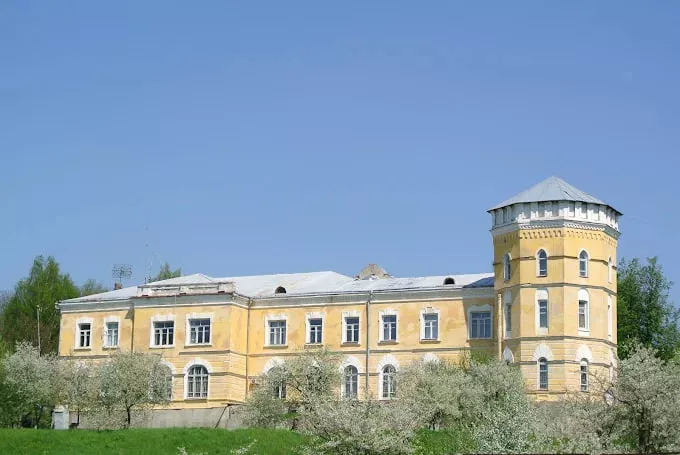
On the banks of the Sluch River in Zviahel stands a building that is hard to confuse with any other city structure. The yellow two-storey house with a faceted tower looks more like a small medieval castle than an ordinary urban manor. This is the Mezentsev Mansion, one of the most interesting architectural landmarks of Zviahel.
The palace has survived to this day with almost no loss of its main volume, but an ordinary tourist will not be able to see it up close: the estate is located in a restricted area. Therefore, today the traveler can only view the structure from the outside.
The history of this place is much older than the building itself. The estate on the right bank of the Sluch River once belonged to the Lubomirski princes, then passed to the Uvarovs, and in the second half of the 19th century, the Mezentsevs became its owners. It was they who gave the estate the appearance it has today.
From the Lubomirskis to the Uvarovs and Mezentsevs
The estate emerged even before the appearance of the modern palace. Its history is connected with the princely family of the Lubomirskis, who owned Zviahel from 1658, and with the estate in Novyi Zviahel — a settlement on the right bank of the Sluch River, actually a suburb of the Zviahel of that time. Novyi Zviahel was incorporated into the city only in the second half of the 1920s.
Later, the estate came into the possession of the Uvarov family. At the beginning of the 19th century, they planted a large arboretum around the residence. It was this park that was an important part of the estate complex, and not just green spaces near the house.
In 1865, Novyi Zviahel passed to the Mezentsevs. According to other sources, the transfer of the estate took place in the context of the family connection of Yevheniia Uvarova with Serhii Mezentsev. The memoirs of Olena Pchilka confirm that the Mezentsev family lived in a large estate outside the city, on the other side of the Sluch River.
It is here that the history of the house, which is called the Mezentsev Palace today, begins.
A palace built like a castle
At the end of the 19th century, Colonel Serhii Mezentsev began the reconstruction of the old estate. The work was completed by his son Borys Mezentsev in 1903 — this is the year currently indicated as the completion date of the palace's construction. The name of the architect has not been definitively established; it is assumed that it could have been Oleksandr Palshau.
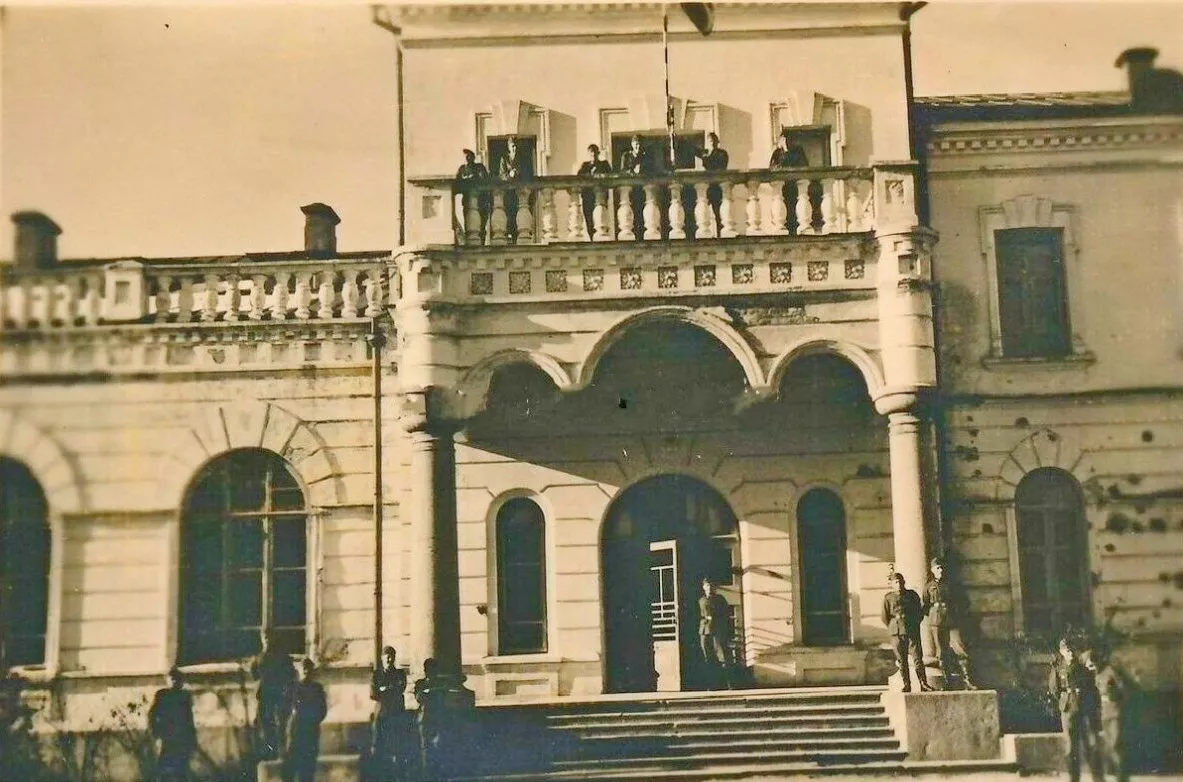
The architecture of the house deliberately creates a romantic image of an ancient castle. The structure mixes motifs of the Renaissance, Baroque, and Classicism — a historicism characteristic of the late 19th century, when architects freely combined forms from different historical epochs.
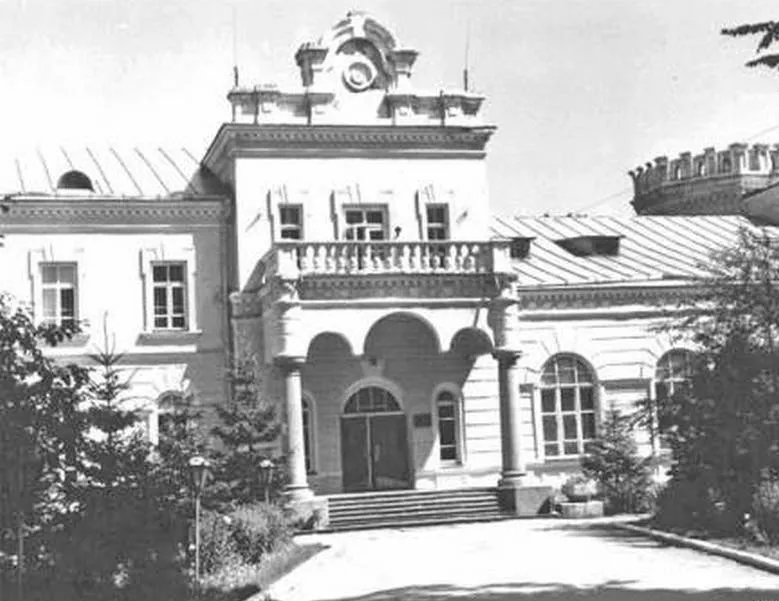
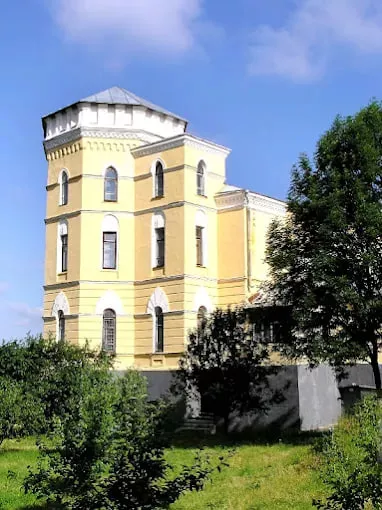
The faceted corner tower with a wide complex cornice and battlements stands out in particular. It is what forms the unusual silhouette of the building. In its composition, the palace even echoes the outlines of the old Zviahel Castle on the opposite bank of the Sluch River.
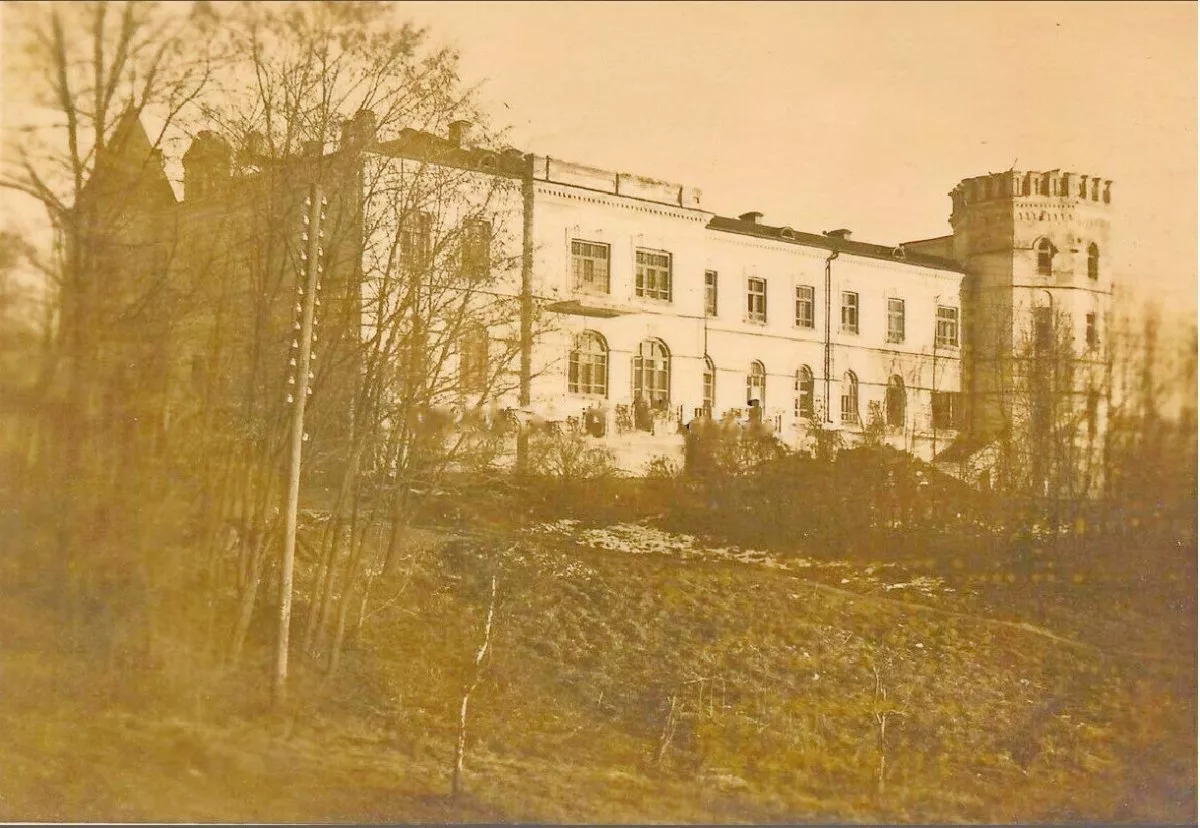
Initially, the structure had two towers, but only one has survived to this day. The second one was destroyed and was never restored later.
What is hidden behind the facade
The building has two floors and consists of two main parts connected by a hall and a wide staircase. Externally, it is distinguished by a plastered facade, yellow coloring, and a complex architectural silhouette.
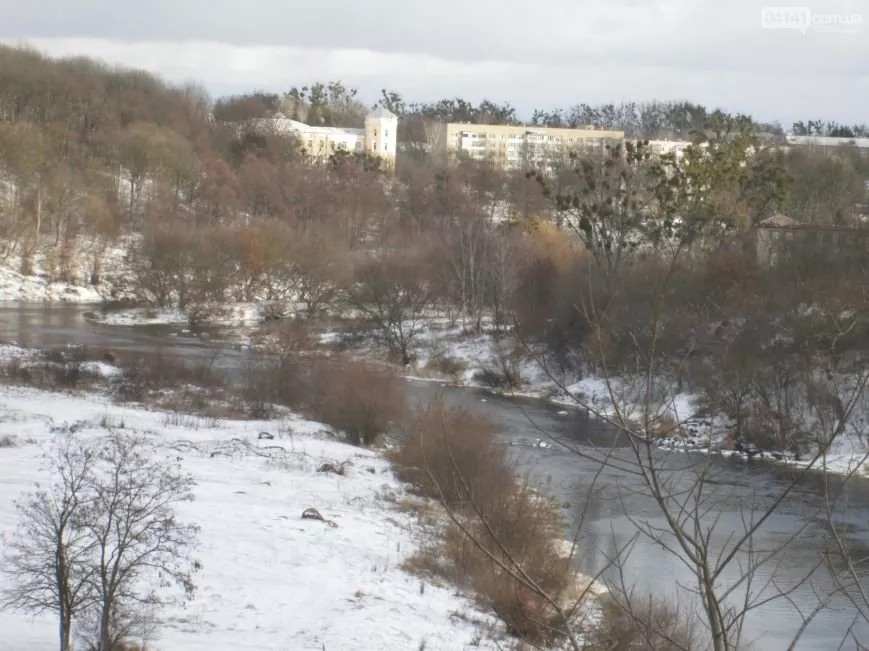
The location by the river was also part of the general design. The palace stands on an elevation near the Sluch River, and its tower and crenellated elements create the impression of a small fortress.
This is neither a medieval castle nor a defensive structure. However, the architect deliberately used the image of a castle, which was very popular in the European estate architecture of that time.
Arboretum and the Stalin Line
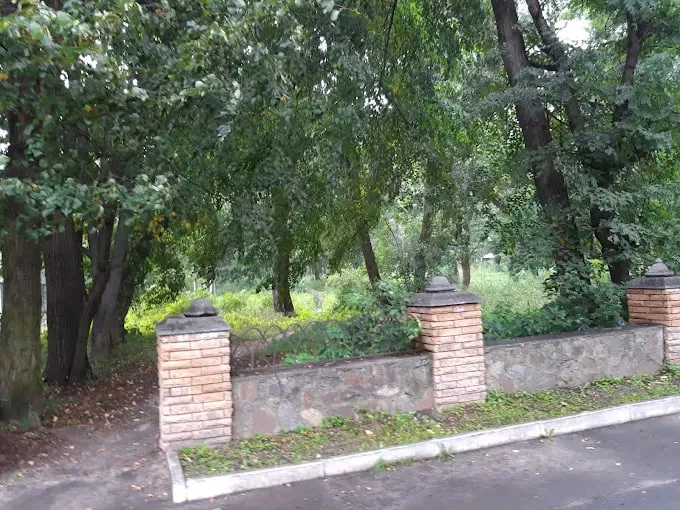
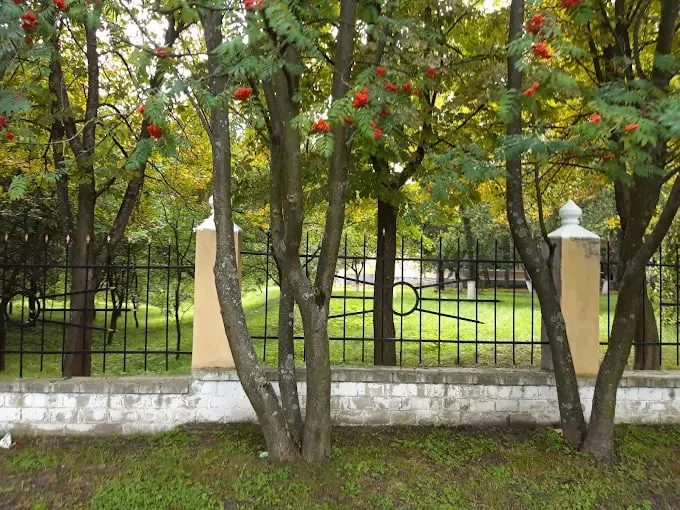
A large arboretum, originally started by the Uvarovs, once stretched around the palace. Today, it is impossible to fully explore this territory.
In the 20th century, the estate was given a completely different purpose. After the revolution, the building was used as an educational institution — an agricultural technical school was located here. Later, the territory passed to the military: in the 1930s, military settlements were established in the Novohrad-Volynskyi area.
In 1932–1940, the headquarters of the 14th Parkhomenko Cavalry Division operated in the building. In 1940–1941, it housed the headquarters of the 9th Mechanized Corps commanded by Konstantin Rokossovsky.
Defensive structures associated with the fortification system known as the "Stalin Line" subsequently appeared on the territory of the former park. Thus, the former aristocratic residence gradually turned into a part of military infrastructure.
What the palace is like today
There is an important nuance that travelers should keep in mind: the palace is not an open tourist attraction. You cannot go inside or into the former arboretum without appropriate permission.
At the same time, the structure itself is not abandoned and has not turned into a ruin. Its main bulk has been preserved, and the building remains a recognizable architectural landmark of this part of Zviahel.
The palace is officially included in the list of architectural monuments of local significance. In the state register of monuments of Zhytomyr region, it is listed as the "Mezentsev Estate House", dating back to the 1890s–1900s; the protection number is 4558-ZhT.
A plaque on the facade recalls another history of the building
The palace has another feature as well — a memorial plaque associated with the military history of the structure. In 1977, a marble plaque was installed on the building in honor of the marshals who served here. Today, the building remains connected to the city's military infrastructure.
Therefore, its history actually consists of several different lives: a princely residence, the Uvarov estate, the Mezentsev family palace, an educational institution, a headquarters for military formations, and a modern military facility.
What is nearby
The palace stands on the right bank of the Sluch, opposite the ruins of the Zviahel Castle. Therefore, even without access to the estate grounds, this part of the city can be included in a historical route.
On the other side of the river are the remains of the Zviahel Fortress, and nearby are the historic city center and the Kosach family house-museum associated with Lesya Ukrainka.
The Mezentsev Palace is one of those sites where the very inaccessibility adds a sense of mystery to the place. Behind the fence lies the former estate with its arboretum, the history of which began back in the days of the Lubomirskis and Uvarovs, while it acquired its modern appearance at the beginning of the 20th century thanks to the Mezentsevs.
Even from afar, it is easy to see why the architects of that time sought to turn the estate into a romantic castle: the tower, the crenellated cornice, the river below, and the old silhouette of the building make it one of Zviahel's most unusual historical structures.
And perhaps the most interesting thing here is that the palace did not simply survive a change of owners. It survived the shift of entire epochs, each of which left its mark upon it.
How to get there
Zviahel lies in the west of the Zhytomyr region, about 90 km from Zhytomyr; buses and trains run to the city. The palace stands on the right bank of the Sluch, in the former Novo-Zviahel: from the historic center, you can walk here across the bridge, and the best view of the structure opens up from the outside, from the riverbank.