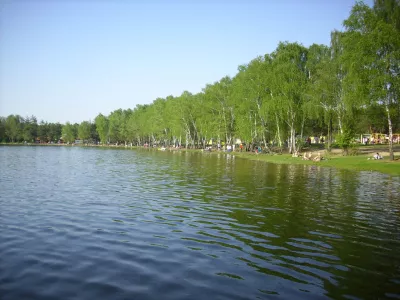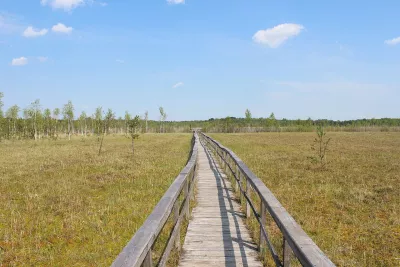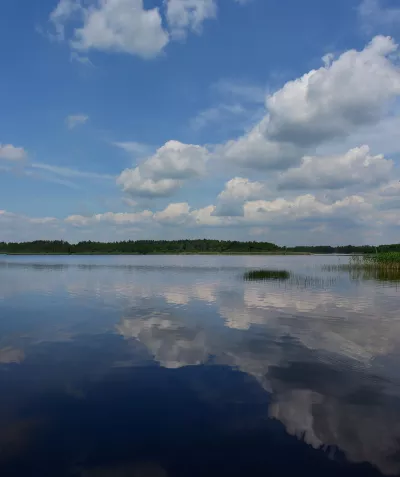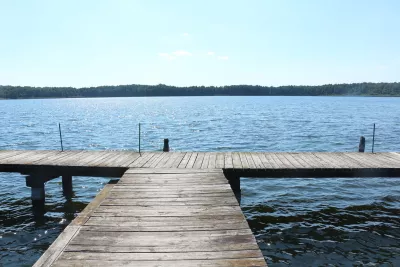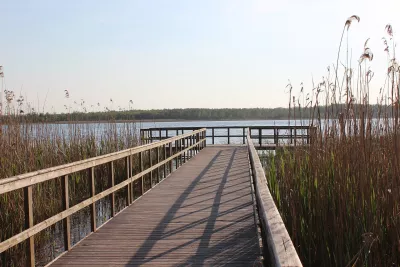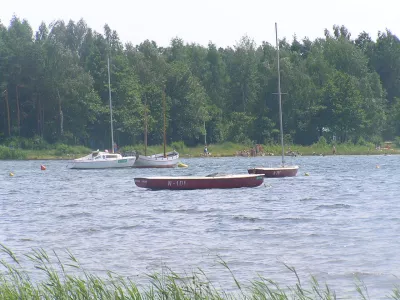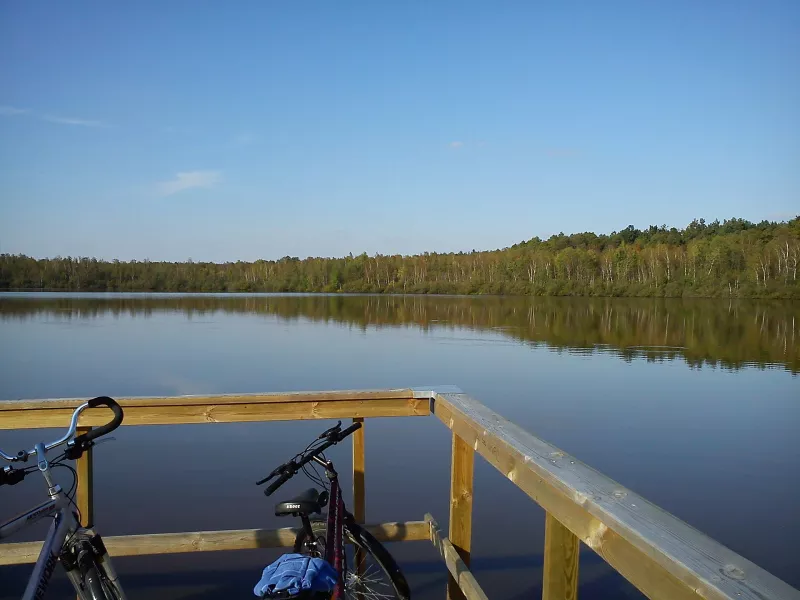
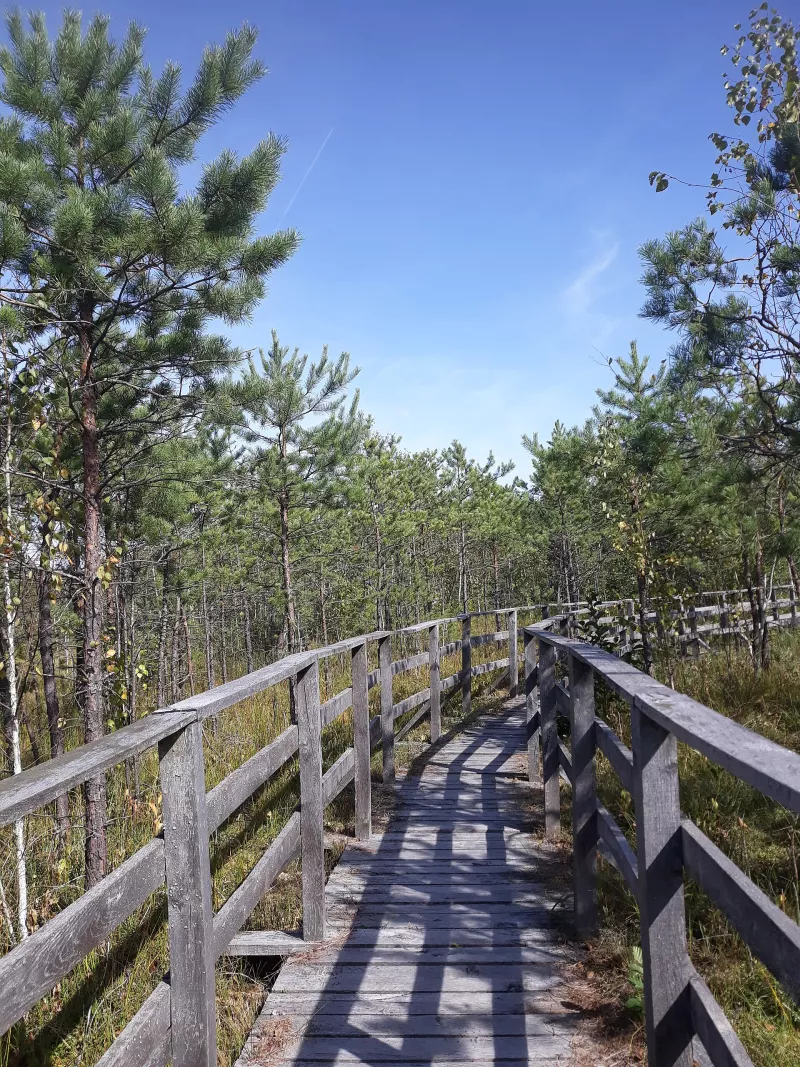

Obradovske Lake is a small forest lake in the Parczew Forests, about 6 km south of Parczew, near the village of Buradów. Since 1975, it has been protected together with the peatland and surrounding forest as a reserve covering about 82 hectares. It is a dystrophic lake: its water is brown from humic substances, and the shores are gradually overgrown with a floating carpet of mosses. A wooden boardwalk leads to the water, ending in a floating platform — one of the easiest ways to see a true Polissia peatland.
Reserve in the Parczew Forests
The reserve was established by order of the Minister of Forestry on March 26, 1975, to preserve the dystrophic lake and the natural peatland and forest communities with rare plants. It is managed by the Parczew Forest District. The territory is part of two Natura 2000 sites — the “Parczewska Osoja” and the bird area “Parczewskie Lasy,” as well as the cross-border biosphere reserve “Western Polissia,” shared with Ukraine and Belarus.
The lake itself is small and shallow: according to a 1988 study, its area did not exceed 12 hectares, and the maximum depth was about one meter. The water level was lowered by a drainage canal dug in 1956, and the lake is gradually overgrowing. Around it stretches a transitional peatland and the swampy pine forests of the Parczew Forests — a massif covering about 136 km² between the Weprz–Krzna canal and the Tyśmienica River.
Sundew and Dwarf Birch
The peatland is home to plants protected in Poland: dwarf birch and Lapland willow — relict species from the Ice Age; round-leaved and intermediate sundew; common cotton-grass; clubmosses Lycopodium clavatum and L. annotinum; wolf’s bane; the blood-red and broad-leaved marsh orchids; marsh helleborine; bladderwort Utricularia breviscapa; Scheuchzeria palustris; and several rare sedges. The Parczew Forests are recognized as an important bird area: black stork, white-tailed eagle, lesser spotted eagle, and corncrake nest here.
Boardwalk Trail
An educational trail “Obradovske Lake” about 800 m long runs through the reserve; approximately 700 m of it is a wooden boardwalk across the most interesting parts of the forest and peatland. At the end of the boardwalk is a floating observation platform on the lake itself. Near the reserve runs the red Partisan Trail from Urszulin to Parczew and a cycling route. Leaving the boardwalk is prohibited: the peat under the moss can be very deep.
Fishing
Fishing is prohibited in Polish reserves unless explicitly allowed by the reserve’s protection document, and no such permission exists for Obradovske. Moreover, the lake itself is unsuitable for fishing: it is shallow, acidic, and dark, poor in fish. It is better to take a rod to the town pond in Parczew, covering 4.6 hectares, where local anglers fish, or to the paid łowisko near the fish ponds in Semeni. Polish fishing regulations apply: a fishing card and permission from the water body user are required.
How to Get There
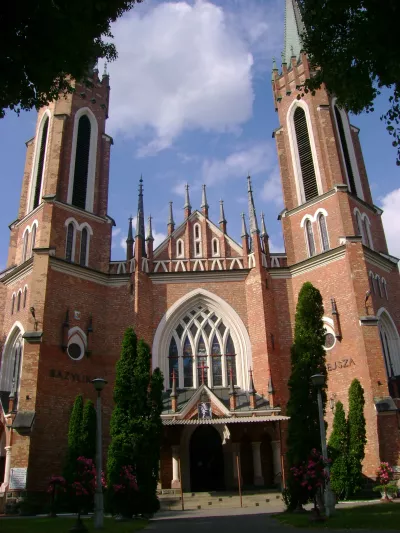
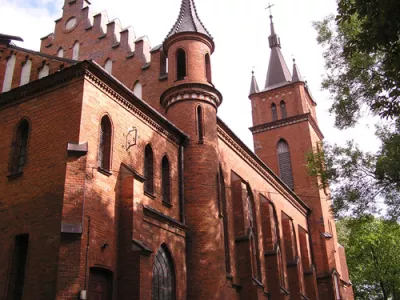
The reserve is located near the village of Buradów on voivodeship road No. 813, about 6 km south of Parczew, where buses and trains run from Lublin (about 60 km). From the road to the lake is a forest road leading to the start of the trail; entry is free, the best time to visit is May–June when orchids bloom, and September. In summer there are many mosquitoes, ticks in the forest, and in hot weather state forests may be temporarily closed. From Parczew also starts the Forest Trail to Białka, and in the town it is worth seeing the Basilica of St. John the Baptist. This is Poland: Ukrainian citizens need a passport for travel abroad.