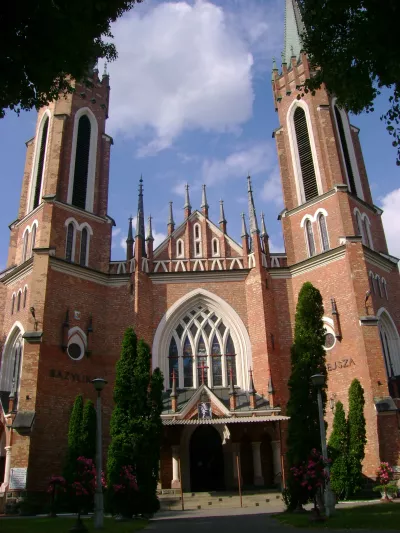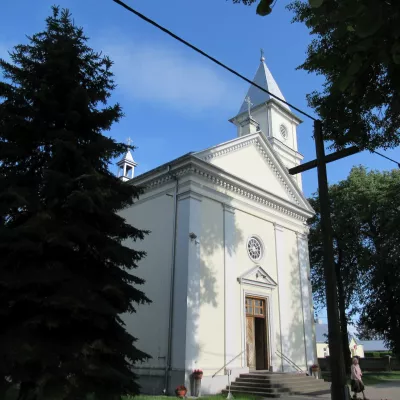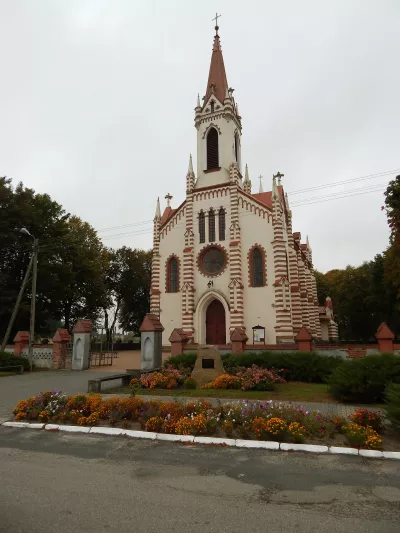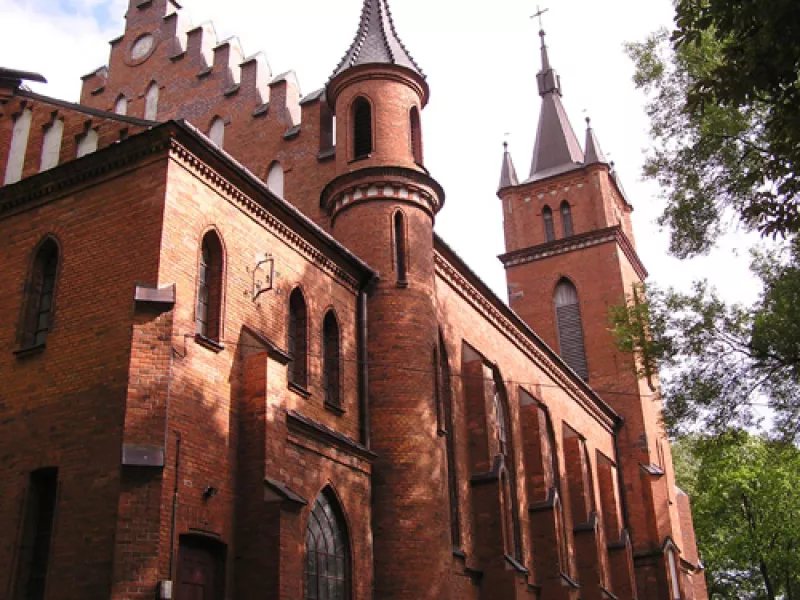

The Church of the Exaltation of the Holy Cross is a parish church in Podedwórze, the center of the gmina in the east of Parczew County, about 22 km from Parczew. Locals call it the “red” church because its neo-Gothic towers are made of red brick, unlike the “white” classical church next door. Both churches are part of the long history of the parish in the village of Opole, which the faithful had to give up for more than forty years.
The Seized White Church
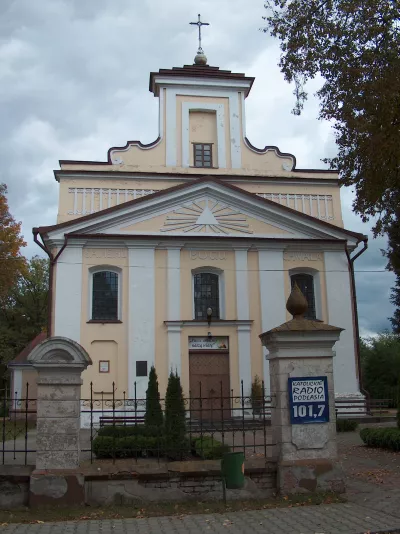
The parish in Opole was founded in 1643. At the beginning of the 19th century, Józef Słubowski began building a family chapel-tomb, which was completed in 1811 by his sons Ignacy and Jan; members of the family were buried in its crypts until 1868. This classical “white” Church of the Annunciation, probably designed by Piotr Aigner, became the parish church. At the end of 1876, the Russian authorities, considering the parish a threat to Orthodoxy, did not allow the appointment of a new parish priest, banned services in 1877, and in 1890 transferred the building to the Orthodox Church. The faithful were served by priests from Sosnowica.
After the Edict of Toleration in 1905, hundreds of former Uniates converted to Catholicism. On 30 April 1906, they occupied the abandoned church without permission, but on 1 November the police expelled them, and later the Orthodox clergy solemnly consecrated the building as a church. The dispute reached the State Duma, which in 1910 rejected the Catholics’ request—but at the same time the government allowed the construction of a new church.
Neo-Gothic Red Brick
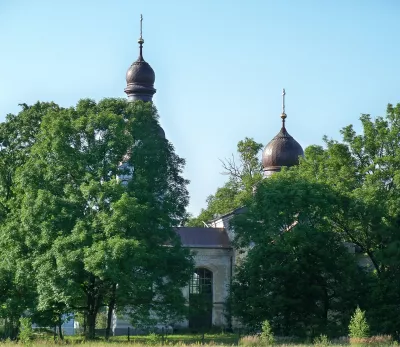
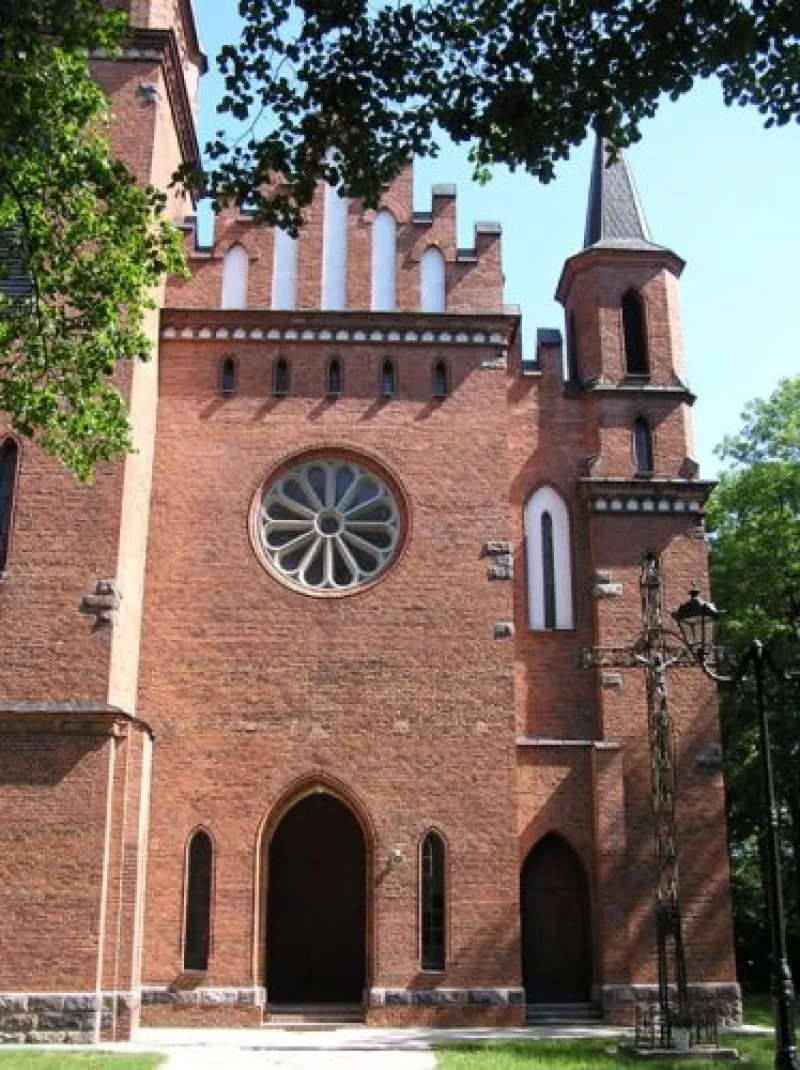
The 1911 design is attributed to Stefan Schiller or Zygmunt Zdanowski, who may have revised Schiller’s concept. It was built between 1911 and 1914 and consecrated in 1914. This is a three-nave hall-type church on a rectangular plan with an asymmetrical façade: a taller massive square tower stands on the southwest corner, a lower one above the second floor transitions into an octagon. Both are topped with slender spires. The façade is decorated with a large rose window with tracery, above it a stepped gable with battlements and pointed niches highlighted by light plaster.
Inside, the nave is divided by pointed arcades on quadrangular pillars with clusters of columns and floral capitals. The naves are covered with ribbed vaults, the presbytery with a star vault. Above the presbytery are three pointed arcades of galleries from which the service can be observed; spiral staircases in round turrets at the northern corners of the building lead to them from the sacristies. The parish was restored in 1919, and the “white” church was returned to the Catholics and became a filial church; General Filip Hauman is buried in its crypt.
The 1646 Chapel
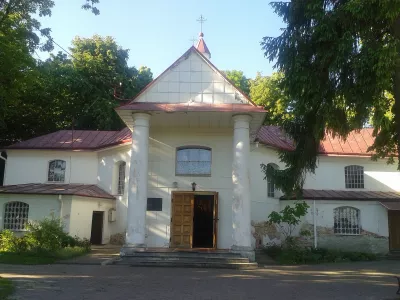
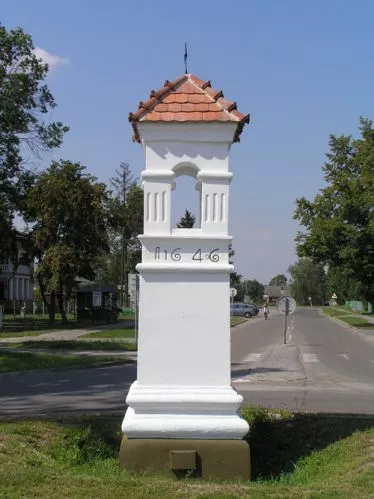
At the crossroads of the roads Vyshnytsia–Kodenets and Mosty–Jabłoń stands a brick chapel from 1646 with an image of Jesus the Meek—one of the oldest monuments of the gmina. Near the white church is a monument from 1807, erected by the sons of Józef Słubowski in honor of their parents, and the village also has monuments to those who died in 1919–1920 and in the fight against the Nazis.
How to Get There
Podedwórze lies about 22 km east of Parczew and 12 km south of Vyshnytsia; public transport is limited, so it is more convenient by car. The red church stands in the center of the village, the white one nearby; the easiest way to enter is before the Sunday service. Nine kilometers west are the Zamoyski Palace in Jabłoń and the former church in Pashenki. More about the region in the article Polish Polissia. This is Poland: Ukrainian citizens need a foreign passport.